Astronomy

Astronomy

Our Universe is amazing and full of cosmic mysteries and curious anomalies. Since the dawn of history, humans have gazed at the night sky and wondered what is really out there. Where can we find extraterrestrials? What would alien worlds look like? There is still so much we don’t know about the Universe.

In this section, we take you on a journey to distant worlds and explore the secrets of our universe. You’ll find here the latest astronomy news, remarkable facts about the cosmos and space mysteries scientists are still trying to solve.

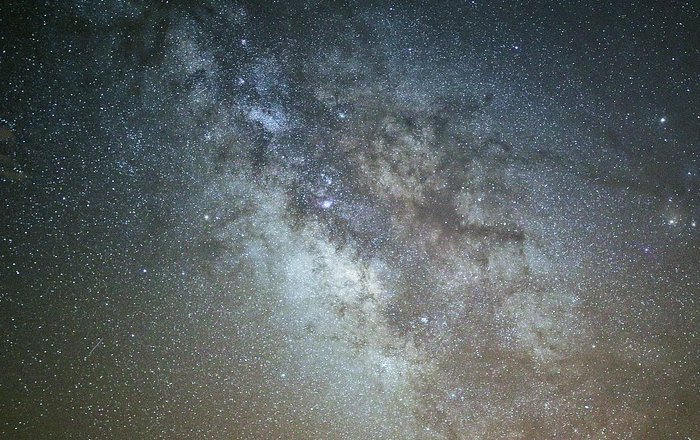
Sky. Image credit: Pixabay

Building Blocks For RNA-Based Life Abound At Center Of Our Galaxy

Eddie Gonzales Jr. – MessageToEagle.com – Nitriles, a class of organic molecules with a cyano group—that is, a carbon atom bound with a triple unsaturated bond to a nitrogen atom—are typically toxic. But paradoxically, they are also a key precursor for molecules essential for life, such as ribonucleotides, composed of the nucleobases or “letters” A,

Building Blocks For RNA-Based Life Abound At Center Of Our Galaxy Read More »
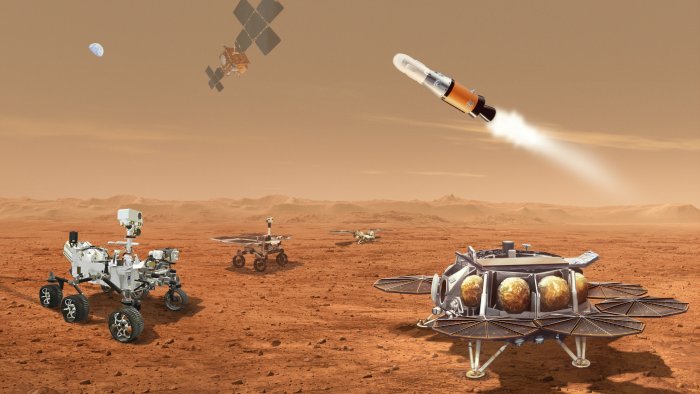
This illustration shows a concept for multiple robots that would team up to ferry to Earth samples collected from the Mars surface by NASA's Mars Perseverance rover. Credit: NASA/ESA/JPL-Caltech

Mission To Bring Samples Of Mars Soil, Rock And Atmosphere Back To Earth – NASA Explains

Eddie Gonzales Jr. – MessageToEagle.com – NASA’s Mars Sample Return Mission aims to bring 30 samples of rock, soil and atmosphere now being collected by the Perseverance rover back to Earth sometime in the early 2030s. The goal is to look for signs of past life and also to find out more about the Red

Mission To Bring Samples Of Mars Soil, Rock And Atmosphere Back To Earth – NASA Explains Read More »

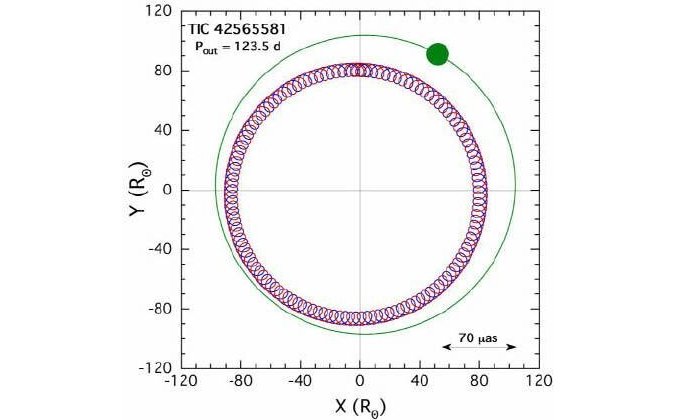
A schematic of a triply eclipsing stellar system as a seen from above the orbital plane. The green circle and green track mark the tertiary star, while the inner red/blue tracks are for the inner eclipsing binary pair. Only about twenty triply eclipsing stellar systems are known; astrnomers have used TESS observations, combined with other datasets, to study six new ones. Credit: Rappaport, et al. 2022

Triply Eclipsing Stellar Systems

Eddie Gonzales Jr. – MessageToEagle.com – Stars with the mass of the sun or larger are typically accompanied by one or more orbiting companion stars. The system forms when gravity contracts the gas and dust of an interstellar cloud until clumps develop that are dense enough to coalesce into stars. Multiple stellar systems develop, according

Triply Eclipsing Stellar Systems Read More »

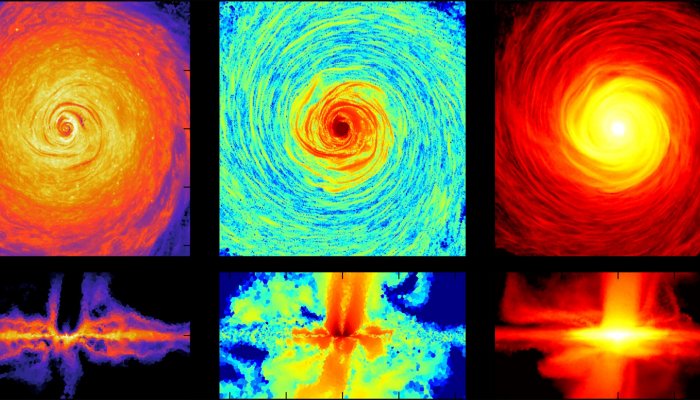
Simulation of a forming disk galaxy, in which cosmic rays are accelerated by supernova remnants and then escape into the interstellar medium. Cross sections of the disk (top) and vertical sections (bottom) show the number density of cosmic ray electrons in steady state (left), magnetic field strength (middle) and radio synchrotron brightness. Credit: Werhahn/AIP

Puzzling Link Between Star Formation And Radio Emission In Galaxies

Eddie Gonzales Jr. – MessageToEagle.com – On the 50th anniversary of the discovery of a close connection between star formation in galaxies and their infrared and radio radiation, researchers at the Leibniz Institute for Astrophysics Potsdam (AIP) have now deciphered the underlying physics. To this end, they used novel computer simulations of galaxy formation with

Puzzling Link Between Star Formation And Radio Emission In Galaxies Read More »

History of the Universe

“Pegasus V” Dwarf Galaxy Located On The Outskirts Of Andromeda – Found

Eddie Gonzales Jr. – MessageToEagle.com – A new fossil galaxy, which was uncovered via a systematic visual search of legacy survey images using the Mayall 4-meter telescope, led by Dr. David Martinez Delgado, could teach scientists about how galaxies form and confirm their understanding of cosmology and dark matter. Image credit: Pixabay Dr. Michelle Collins,

“Pegasus V” Dwarf Galaxy Located On The Outskirts Of Andromeda – Found Read More »

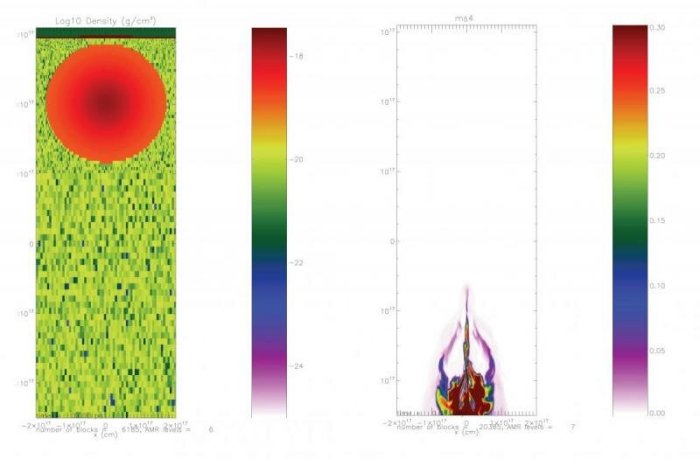
The left panel shows a cross section through the dense cloud core (orange) that is about to be struck by a supernova shock wave (dark green) moving downward at 40 km/sec. The ambient molecular cloud gas and dust (yellow and light green) surrounding the cloud core on the left is swept away by the shock front, as shown on the right after 63,000 years, when the cloud core has been crushed by the shock front into forming the proto-sun and protoplanetary disk on a much smaller scale than can be depicted here. The box is about 1/3 of a parsec in length. Credit: Alan Boss

Unraveling A Meteorite Mystery Reveals Solar System Origin Story

Eddie Gonzales Jr. – MessageToEagle.com – The violent event that likely preceded our solar system’s formation holds the solution to a longstanding meteorite mystery, according to a new study. The left panel shows a cross section through the dense cloud core (orange) that is about to be struck by a supernova shock wave (dark green) moving

Unraveling A Meteorite Mystery Reveals Solar System Origin Story Read More »

Examining The Supermassive Black Hole In Our Galaxy

Examining The Supermassive Black Hole In Our Galaxy

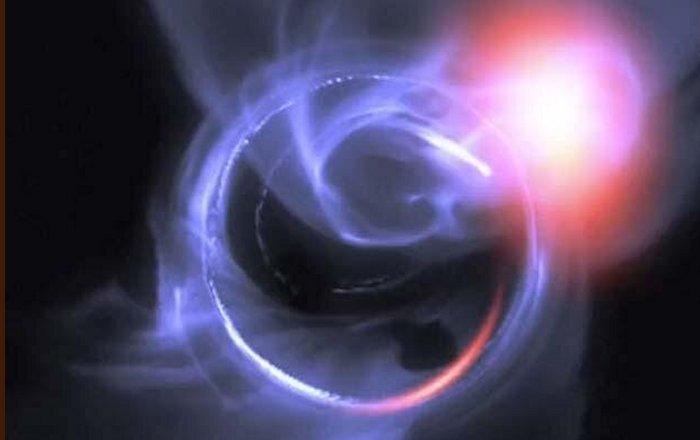
Eddie Gonzales Jr. – MessageToEagle.com – The supermassive black hole (SMBH) at our galaxy’s core, Sagittarius A*, is modest in size with only 4.15 million solar-masses. The Event Horizon Telescope (EHT) recently released a dramatic submillimeter image of it as seen illuminated by its glowing environment. A visualization of simulated flaring activity and clouds of

Examining The Supermassive Black Hole In Our Galaxy Read More »