Astronomy

Astronomy

Our Universe is amazing and full of cosmic mysteries and curious anomalies. Since the dawn of history, humans have gazed at the night sky and wondered what is really out there. Where can we find extraterrestrials? What would alien worlds look like? There is still so much we don’t know about the Universe.

In this section, we take you on a journey to distant worlds and explore the secrets of our universe. You’ll find here the latest astronomy news, remarkable facts about the cosmos and space mysteries scientists are still trying to solve.

Some Asteroids 'Aged Early' By Sun, NASA Finds

Some Asteroids ‘Aged Early’ By Sun, NASA Finds

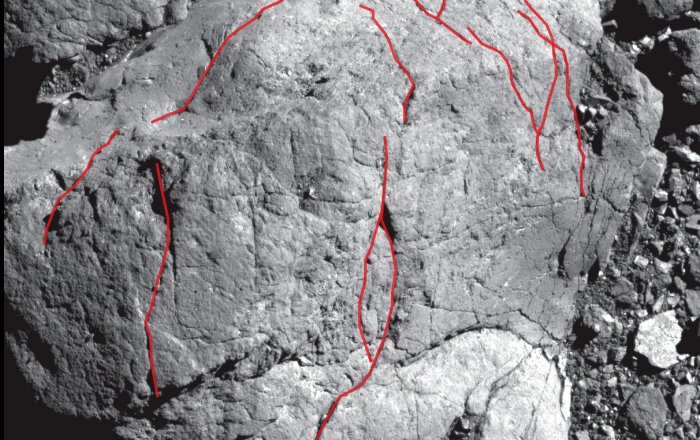
Eddie Gonzales Jr. – MessageToEagle.com – Scientists from NASA’s OSIRIS-REx mission recently learned that surface regeneration happens a lot quicker on asteroids than on Earth. By analyzing rock fractures on asteroid Bennu from high-resolution images taken by the OSIRIS-REx spacecraft, the team discovered that the Sun’s heat fractures rocks on Bennu in just 10,000 to

Some Asteroids ‘Aged Early’ By Sun, NASA Finds Read More »
Credit: NASA, ESA, the Hubble Heritage-Hubble Collaboration, and A. Evans

How Do Galaxies Evolve? Possible Missing Link Found

Eddie Gonzales Jr. – MessageToEagle.com – A University of Massachusetts Amherst undergraduate student has contributed significant work regarding the growth of stars and black holes, providing key insight into how they are linked. This new information will allow the James Webb Space Telescope (JWST) to more efficiently untangle how, exactly, galaxies work. Credit: NASA, ESA,

How Do Galaxies Evolve? Possible Missing Link Found Read More »

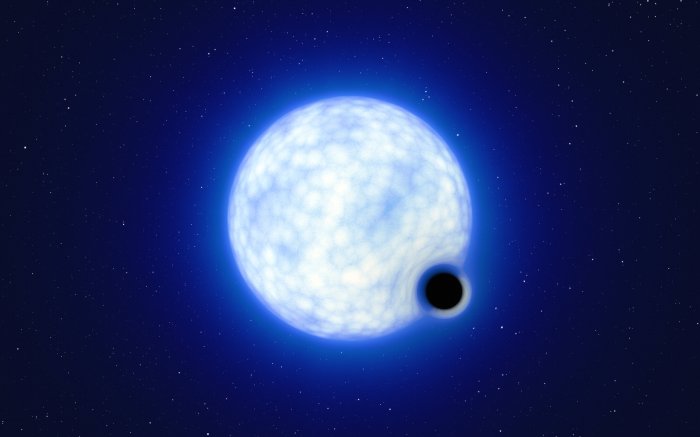
This artist’s impression shows what the binary system VFTS 243 might look like if we were observing it up close. The system, which is located in the Tarantula Nebula in the Large Magellanic Cloud, is composed of a hot, blue star with 25 times the Sun’s mass and a black hole, which is at least nine times the mass of the Sun. The sizes of the two binary components are not to scale: in reality, the blue star is about 200 000 times larger than the black hole. Note that the 'lensing' effect around the black hole is shown for illustration purposes only, to make this dark object more noticeable in the image. The inclination of the system means that, when looking at it from Earth, we cannot observe the black hole eclipsing the star. Credit: Credit: ESO/L. Calçada

‘Black Hole Police’ Discover A Dormant Black Hole Outside The Milky Way Galaxy

Eddie Gonzales Jr. – MessageToEagle.com – A team of international experts who are known for debunking black hole discoveries have found a dormant stellar-mass black hole in the Large Magellanic Cloud, a galaxy that neighbors the Milky Way. The team includes Kareem El-Badry—nicknamed by fellow astronomers as the “black hole destroyer”—of the Center for Astrophysics

‘Black Hole Police’ Discover A Dormant Black Hole Outside The Milky Way Galaxy Read More »

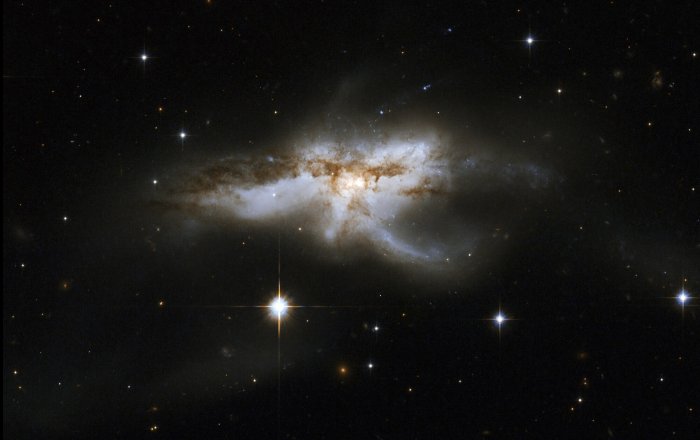
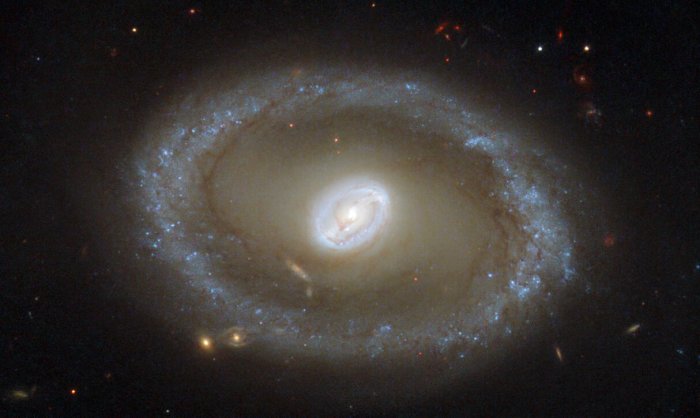
The ring galaxy NGC 3081, imaged by the Hubble Space Telescope. Credit: ESA/Hubble & NASA

Human And Machine Intelligence Work Together To Find 40,000 Ring Galaxies

Eddie Gonzales Jr. – MessageToEagle.com – Human and machine intelligence worked together to find 40,000 ring galaxies, scientists at the National Astronomy Meeting will announce this week. Dr. Mike Walmsley of the University of Manchester and the Galaxy Zoo collaboration will present the new work, describing how this “cyborg” approach measured the shapes of millions of

Human And Machine Intelligence Work Together To Find 40,000 Ring Galaxies Read More »

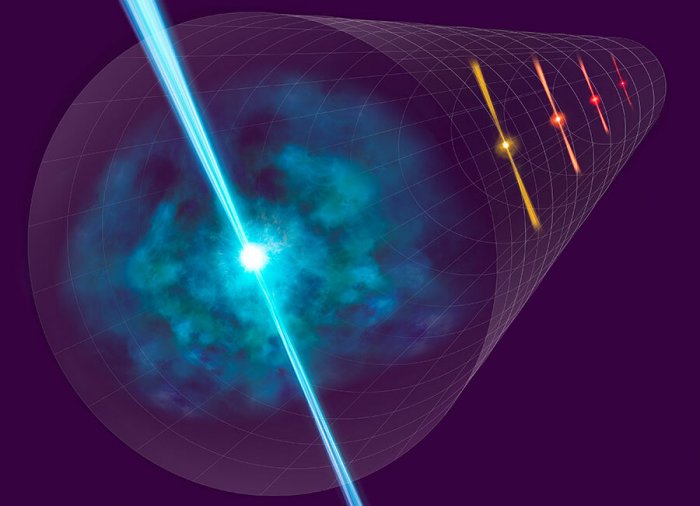
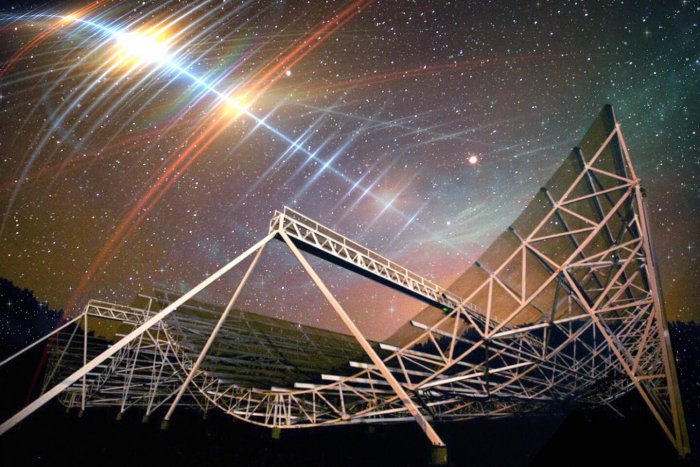
Astronomers detected a persistent radio signal from a far-off galaxy that appears to flash with surprising regularity. Named FRB 20191221A, this fast radio burst, or FRB, is currently the longest-lasting FRB, with the clearest periodic pattern, detected to date. Pictured is the large radio telescope CHIME that picked up the FRB. Credit: CHIME, with background edited by MIT News

A Radio ‘Heartbeat’ Billions Of Light-Years From Earth – Detected

Eddie Gonzales Jr. – MessageToEagle.com – Astronomers at MIT and elsewhere have detected a strange and persistent radio signal from a far-off galaxy that appears to be flashing with surprising regularity. The signal is classified as a fast radio burst, or FRB—an intensely strong burst of radio waves of unknown astrophysical origin, that typically lasts

A Radio ‘Heartbeat’ Billions Of Light-Years From Earth – Detected Read More »

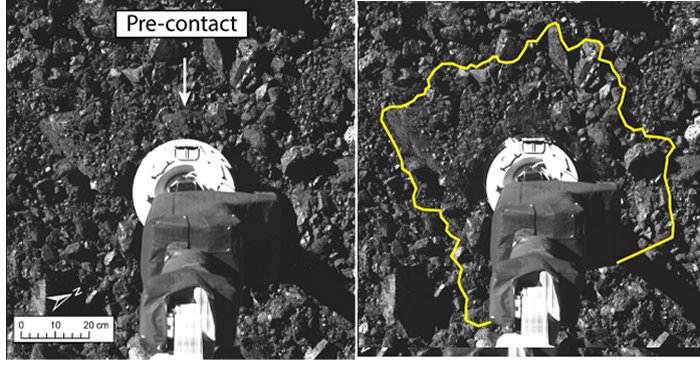
An SwRI-led study found that the surface regolith of the asteroid Bennu is primarily loose rubble. Images taken before and after the touch-and-go sample collection indicate surface disturbances up to 15 inches away. Credit: NASA/Goddard/University of Arizona

New Insights About The Surface And Structure Of Asteroid Bennu

Eddie Gonzales Jr. – MessageToEagle.com – When NASA’s OSIRIS-REx spacecraft collected samples from asteroid Bennu’s surface in 2020, forces measured during the interaction provided scientists with a direct test of the poorly understood near-subsurface physical properties of rubble-pile asteroids. Now, a Southwest Research Institute-led study has characterized the layer just below the asteroid’s surface as

New Insights About The Surface And Structure Of Asteroid Bennu Read More »