Astronomy

Astronomy

Our Universe is amazing and full of cosmic mysteries and curious anomalies. Since the dawn of history, humans have gazed at the night sky and wondered what is really out there. Where can we find extraterrestrials? What would alien worlds look like? There is still so much we don’t know about the Universe.

In this section, we take you on a journey to distant worlds and explore the secrets of our universe. You’ll find here the latest astronomy news, remarkable facts about the cosmos and space mysteries scientists are still trying to solve.

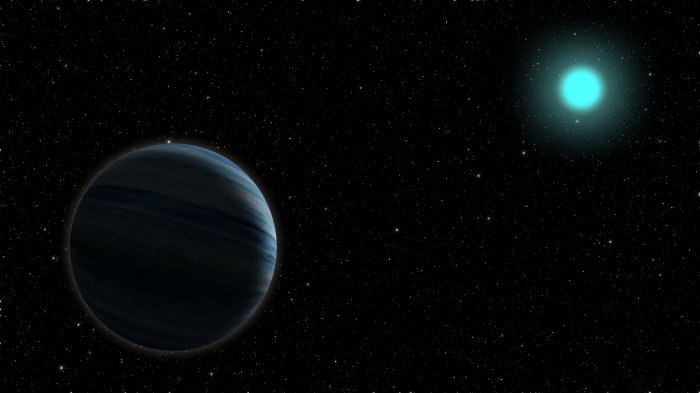
Artist's concept of a Neptune-sized planet, left, around a blue, A-type star. UC Berkeley astronomers have discovered a hard-to-find gas giant around one of these bright, but short-lived, stars, right at the edge of the hot Neptune desert where the star's strong radiation likely strips any giant planet of its gas. Credit: Steven Giacalone, UC Berkeley

Brightest Stars In The Night Sky Can Strip Neptune-Sized Planets To Their Rocky Cores

Eddie Gonzales Jr. – MessageToEagle.com – Over the last 25 years, astronomers have found thousands of exoplanets around stars in our galaxy, but more than 99% of them orbit smaller stars—from red dwarfs to stars slightly more massive than our sun, which is considered an average-sized star. Artist’s concept of a Neptune-sized planet, left, around

Brightest Stars In The Night Sky Can Strip Neptune-Sized Planets To Their Rocky Cores Read More »
Subsurface Water On Mars Defy Expectations: Physics Connects Seismic Data To Properties Of Rocks And Sediments

Subsurface Water On Mars Defy Expectations: Physics Connects Seismic Data To Properties Of Rocks And Sediments

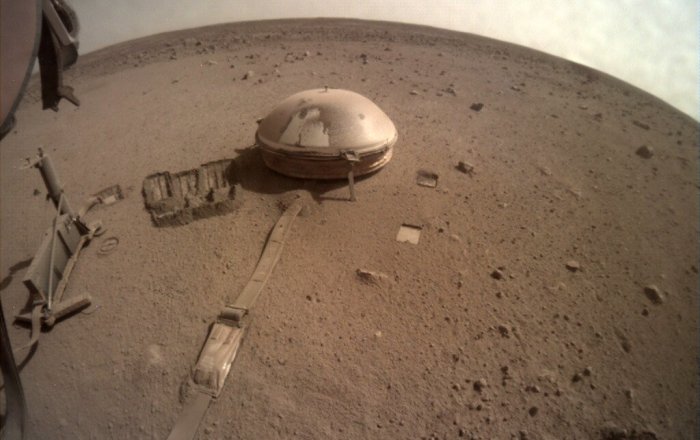
Eddie Gonzales Jr. – MessageToEagle.com – A new analysis of seismic data from NASA’s Mars InSight mission has revealed a couple of surprises. The first surprise: the top 300 meters of the subsurface beneath the landing site near the Martian equator contains little or no ice. Credit: NASA/JPL-Caltech “We find that Mars’ crust is weak

Subsurface Water On Mars Defy Expectations: Physics Connects Seismic Data To Properties Of Rocks And Sediments Read More »

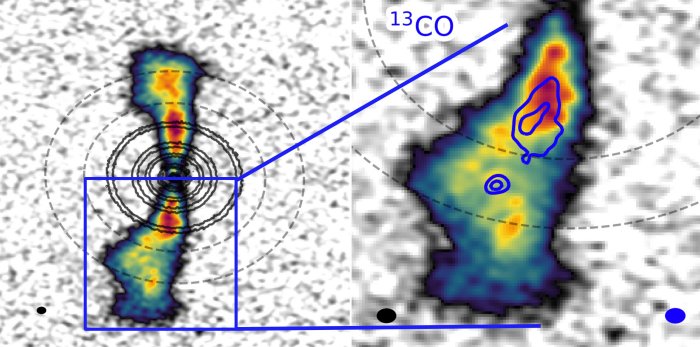
Scientists studying the young star AS 209 have detected gas in a circumplanetary disk for the first time, which suggests the star system may be harboring a very young Jupiter-mass planet. Science images from the research show (right) blob-like emissions of light coming from otherwise empty gaps in the highly-structured, seven-ring disk (left). Credit: ALMA (ESO/NAOJ/NRAO), J. Bae (U. Florida)

First-Ever Detection Of Gas In A Circumplanetary Disk

Eddie Gonzales Jr. – MessageToEagle.com – Scientists using the Atacama Large Millimeter/submillimeter Array (ALMA) and partners at the National Radio Astronomy Observatory (NRAO) have made the first-ever detection of gas in an circumplanetary disk. What’s more, the detection also suggests the presence of a very young exoplanet. Scientists studying the young star AS 209 have

First-Ever Detection Of Gas In A Circumplanetary Disk Read More »

Researchers Aim To Turn Martian Air, Dirt And Sunlight Into Iron

Researchers Aim To Turn Martian Air, Dirt And Sunlight Into Iron

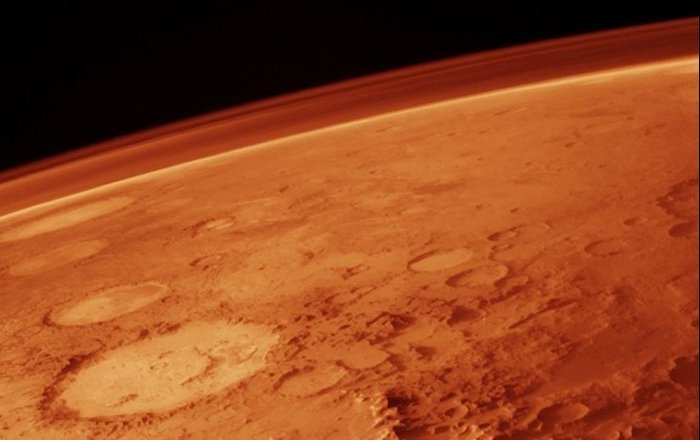
Eddie Gonzales Jr. – MessageToEagle.com – A team of researchers, led by Swinburne’s Professor Akbar Rhamdhani, has published the first detailed study of its kind on metal production on another planet. Mars. WikiImages – Pixabay The team are focused on metal extraction on Mars. They are developing a process that would take processed air, dirt

Researchers Aim To Turn Martian Air, Dirt And Sunlight Into Iron Read More »

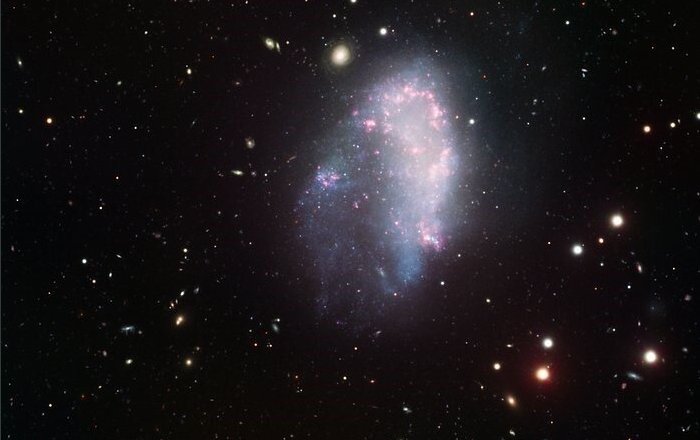
The dwarf galaxy NGC1427A flies through the Fornax galaxy cluster and undergoes disturbances which would not be possible if this galaxy were surrounded by a heavy and extended dark matter halo, as required by standard cosmology. Credit: ESO

No Trace Of Dark Matter Halos – Fornax Cluster Is Free From Them

Eddie Gonzales Jr. – MessageToEagle.com – According to the standard model of cosmology, the vast majority of galaxies are surrounded by a halo of dark matter particles. This halo is invisible, but its mass exerts a strong gravitational pull on galaxies in the vicinity. The dwarf galaxy NGC1427A flies through the Fornax galaxy cluster and

No Trace Of Dark Matter Halos – Fornax Cluster Is Free From Them Read More »

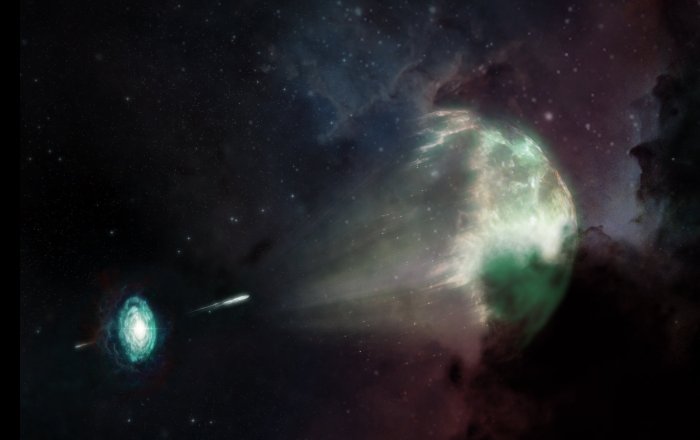
In a first for radio astronomy, scientists have detected millimeter-wavelength light from a short-duration gamma-ray burst. This artist's conception shows the merger between a neutron star and another star (seen as a disk, lower left) which caused an explosion resulting in the short-duration gamma-ray burst, GRB 211106A (white jet, middle), and left behind what scientists now know to be one of the most luminous afterglows on record (semi-spherical shock wave mid-right). While dust in the host galaxy obscured most of the visible light (shown as colors), millimeter light from the event (depicted in green) was able to escape and reach the Atacama Large Millimeter/submillimeter Array (ALMA), giving scientists an unprecedented view of this cosmic explosion. From the study, the team confirmed that GRB 211106A is one of the most energetic short-duration GRBs ever observed. Credit: ALMA (ESO/NAOJ/NRAO), M. Weiss (NRAO/AUI/NSF)

Explosive Neutron Star Merger Captured For The First Time In Millimeter Light

Eddie Gonzales Jr. – MessageToEagle.com – Scientists using the Atacama Large Millimeter/submillimeter Array (ALMA)—an international observatory co-operated by the U.S. National Science Foundation’s National Radio Astronomy Observatory (NRAO)—have for the first time recorded millimeter-wavelength light from a fiery explosion caused by the merger of a neutron star with another star. In a first for radio

Explosive Neutron Star Merger Captured For The First Time In Millimeter Light Read More »

Credit: Monash University

New Telescope Will Detect Gravitational Wave Events

Eddie Gonzales Jr. – MessageToEagle.com – A new telescope, made up of two identical arrays on opposite sides of the planet, will track down sources of gravitational waves. Credit: Monash University The Gravitational-wave Optical Transient Observer (GOTO), led by the University of Warwick, signals a new era of gravitational wave science. Deployed across two antipodal

New Telescope Will Detect Gravitational Wave Events Read More »

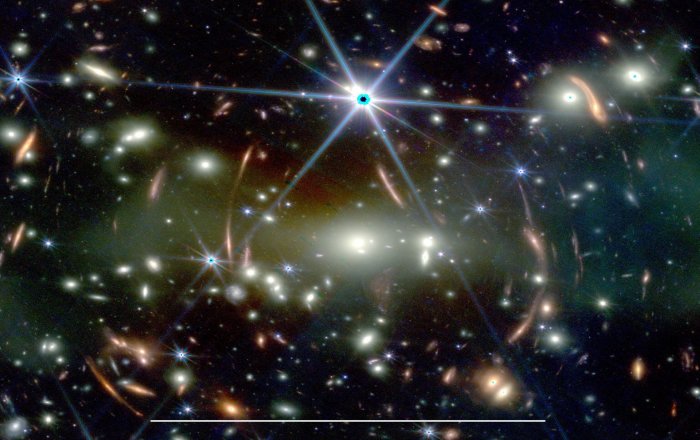
This JWST image shows the galaxy cluster SMACS J0723.3−7327 with a large number of lensed background galaxies. The white bar at the bottom corresponds to 50 arcsec, which is approximately the maximum size of Jupiter observed from Earth. Credit: NASA, ESA, CSA and STScI

Improved Model For The Mass Distribution Of Galaxy Cluster SMACS J0723.3−7327 Thanks To Webb Telescope Image 

Eddie Gonzales Jr. – MessageToEagle.com – Using the first science image released by the James Webb Space Telescope (JWST) this month, an international team of scientists with significant contribution from the Technical University of Munich (TUM) has built an improved model for the mass distribution of the galaxy cluster SMACS J0723.3-7327. This JWST image shows

Improved Model For The Mass Distribution Of Galaxy Cluster SMACS J0723.3−7327 Thanks To Webb Telescope Image  Read More »

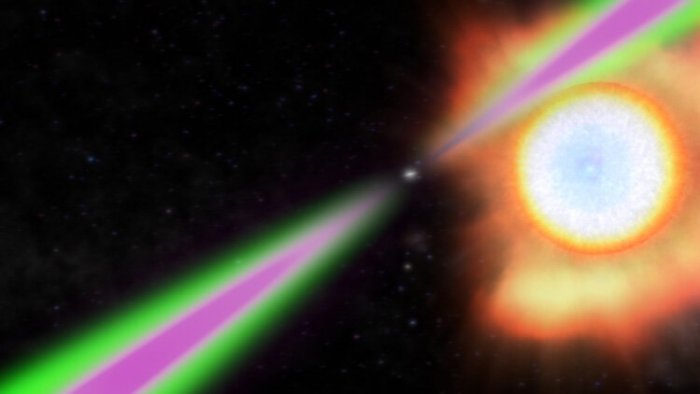
A spinning neutron star periodically swings its radio (green) and gamma-ray (magenta) beams past Earth in this artist’s concept of a black widow pulsar. The neutron star/pulsar heats the facing side of its stellar partner (right) to temperatures twice as hot as the sun’s surface and slowly evaporates it. Credit: NASA’s Goddard Space Flight Center

A ‘Black Widow’ Eating Its Mate Is Heaviest Neutron Star To Date

Eddie Gonzales Jr. – MessageToEagle.com – A dense, collapsed star spinning 707 times per second—making it one of the fastest spinning neutron stars in the Milky Way galaxy—has shredded and consumed nearly the entire mass of its stellar companion and, in the process, grown into the heaviest neutron star observed to date. Weighing this record-setting

A ‘Black Widow’ Eating Its Mate Is Heaviest Neutron Star To Date Read More »