Astronomy

Astronomy

Our Universe is amazing and full of cosmic mysteries and curious anomalies. Since the dawn of history, humans have gazed at the night sky and wondered what is really out there. Where can we find extraterrestrials? What would alien worlds look like? There is still so much we don’t know about the Universe.

In this section, we take you on a journey to distant worlds and explore the secrets of our universe. You’ll find here the latest astronomy news, remarkable facts about the cosmos and space mysteries scientists are still trying to solve.

Astrophysicists Chronicle The History Of Mathematical Cosmology

Astrophysicists Chronicle The History Of Mathematical Cosmology

Eddie Gonzales Jr. – MessageToEagle.com – RUDN University astrophysicists have gathered the most important discoveries of modern cosmology from 1917 to our time. The collected data became an introduction to Philosophical Transactions of the Royal Society A in two parts: from 1917 to 1980 and from 1980 to our time. Luminas_Art – Pixabay Cosmology, the

Astrophysicists Chronicle The History Of Mathematical Cosmology Read More »

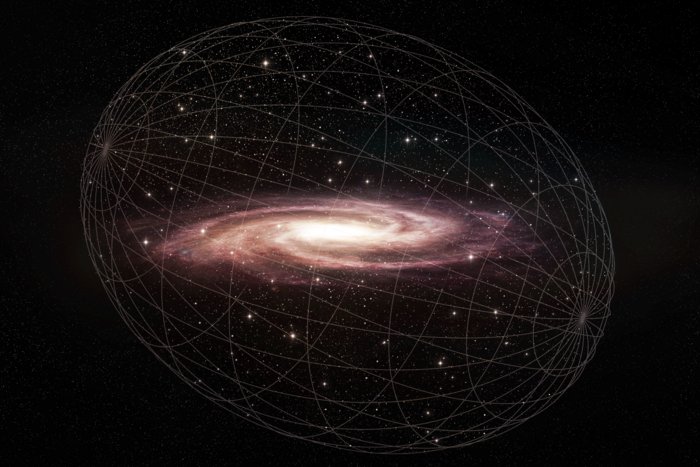
Astronomers have discovered that the Milky Way galaxy's stellar halo -- a cloud of diffuse stars around all galaxies -- is zeppelin-shaped and tilted. This artist's illustration emphasizes the shape of the three-dimensional halo surrounding our galaxy. CREDIT Melissa Weiss/Center for Astrophysics | Harvard & Smithsonian

Tilt In Our Stars: The Shape Of The Milky Way’s Halo Of Stars Is Realized

Eddie Gonzales Jr. – MessageToEagle.com –  A new study has revealed the true shape of the diffuse cloud of stars surrounding the disk of our galaxy. For decades, astronomers have thought that this cloud of stars—called the stellar halo—was largely spherical, like a beach ball. Now a new model based on modern observations shows the

Tilt In Our Stars: The Shape Of The Milky Way’s Halo Of Stars Is Realized Read More »

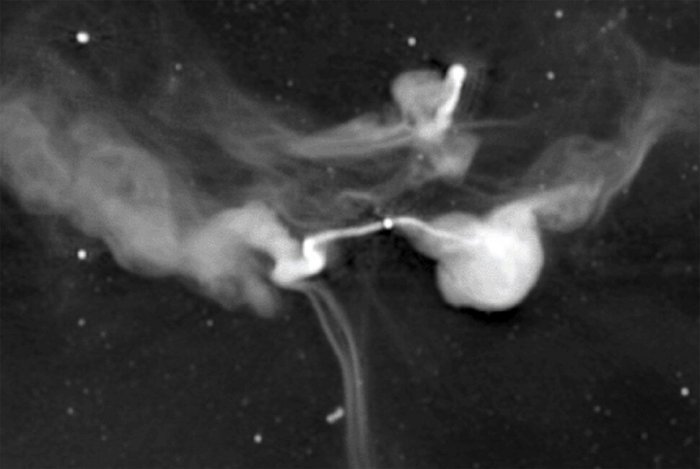
Large-scale magnetic filaments spill downward from a black hole's jet, located in a distant cluster galaxy. Credit: Rudnick and collaborators, 2022

The Milky Way’s Mysterious Filaments Have ‘Older, Distant Cousins’

Eddie Gonzales Jr. – MessageToEagle.com – Northwestern University astrophysicist Farhad Zadeh has been fascinated and puzzled by a family of large-scale, highly organized magnetic filaments dangling in the center of the Milky Way ever since he first discovered them in the early 1980s. Now, 40 years later, Zadeh remains just as fascinated—but perhaps slightly less

The Milky Way’s Mysterious Filaments Have ‘Older, Distant Cousins’ Read More »

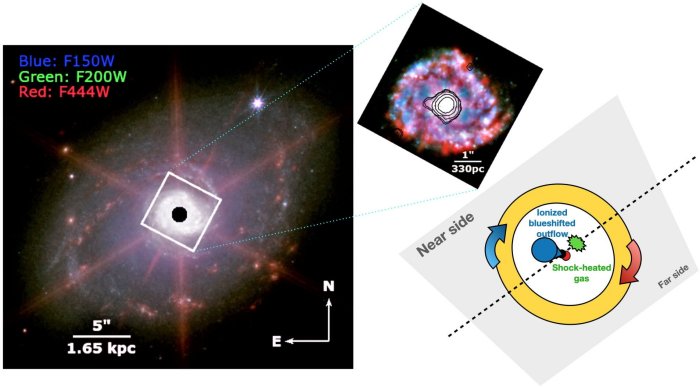
Credit: University of California, Irvine

Interactions Between Black Hole-Dominated Galactic Nucleus And Surrounding Star-Forming Regions – Analyzed

Eddie Gonzales Jr. – MessageToEagle.com – First in line to receive data transmissions from the James Webb Space Telescope, a team of astronomers at the University of California, Irvine and other institutions is using the unprecedentedly clear observations to reveal the secret inner workings of galaxies. Credit: University of California, Irvine In a paper being

Interactions Between Black Hole-Dominated Galactic Nucleus And Surrounding Star-Forming Regions – Analyzed Read More »

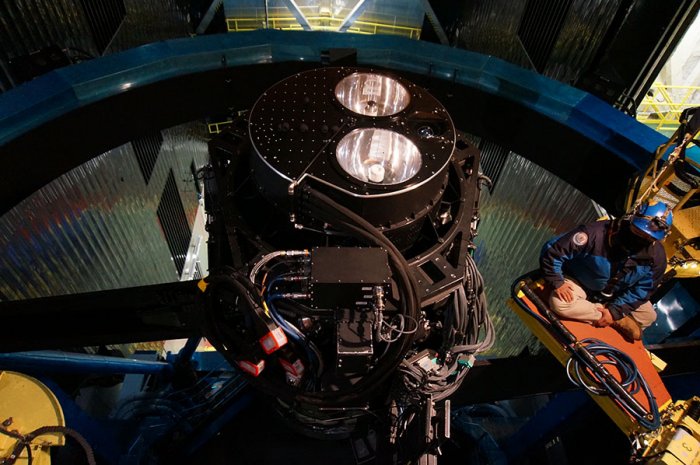
The new instrument for capturing cosmic rainbows mounted on the top of the Subaru Telescope. (Credit: Kavli IPMU

2400 New Eyes On The Sky To See Cosmic Rainbows

Eddie Gonzales Jr. – MessageToEagle.com – The Subaru Telescope successfully demonstrated engineering first light with a new instrument that will use about 2400 fiberoptic cables to capture the light from heavenly objects. Full operation is scheduled to start around 2024. The ability to observe thousands of objects simultaneously will provide unprecedented amounts of data to

2400 New Eyes On The Sky To See Cosmic Rainbows Read More »

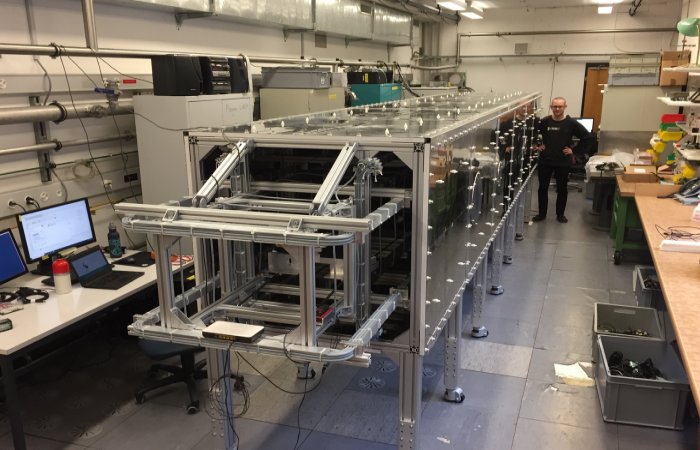
Part of the experimental apparatus in the laboratory in Bern with PhD student Ivo Schulthess. Credit: F. Piegsa

Searching For Traces Of Dark Matter With Neutron Spin Clocks

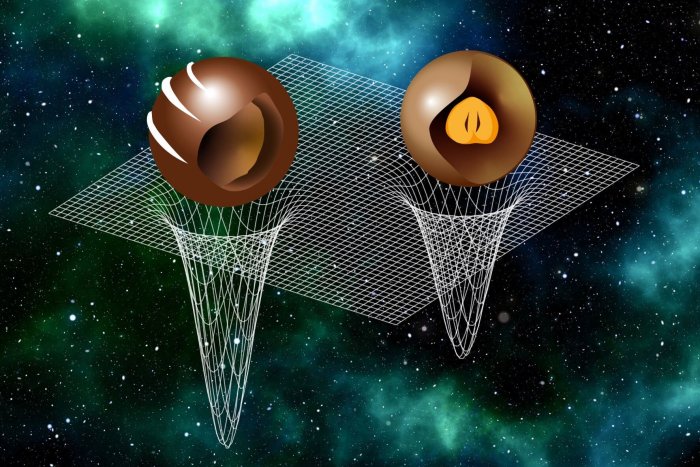
Eddie Gonzales Jr. – MessageToEagle.com – Cosmological observations of the orbits of stars and galaxies enable clear conclusions to be drawn about the attractive gravitational forces that act between the celestial bodies. Part of the experimental apparatus in the laboratory in Bern with PhD student Ivo Schulthess. Credit: F. Piegsa The astonishing finding: Visible matter

Searching For Traces Of Dark Matter With Neutron Spin Clocks Read More »