Astronomy

Astronomy

Our Universe is amazing and full of cosmic mysteries and curious anomalies. Since the dawn of history, humans have gazed at the night sky and wondered what is really out there. Where can we find extraterrestrials? What would alien worlds look like? There is still so much we don’t know about the Universe.

In this section, we take you on a journey to distant worlds and explore the secrets of our universe. You’ll find here the latest astronomy news, remarkable facts about the cosmos and space mysteries scientists are still trying to solve.

What It Would Take To Discover Life On Saturn's Icy Moon Enceladus

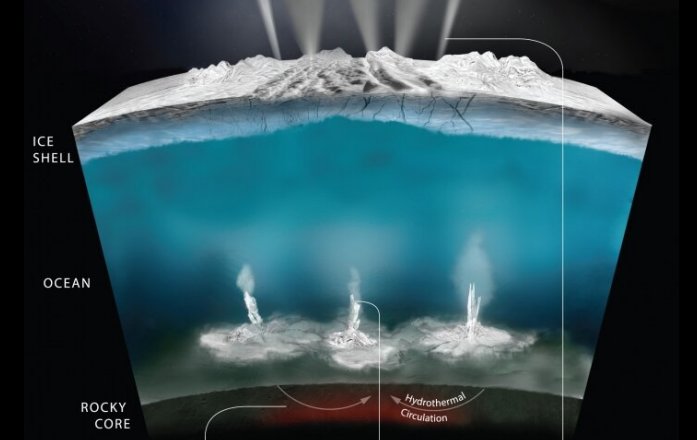
What It Would Take To Discover Life On Saturn’s Icy Moon Enceladus

Eddie Gonzales Jr. – MessageToEagle.com – Surrounded by a vast ocean underneath a thick ice shell, Enceladus is a hot candidate for potentially harboring alien life. A team of researchers led by the University of Arizona concluded that a future mission could provide answers even without landing on the tiny world. This graphic depicts how

What It Would Take To Discover Life On Saturn’s Icy Moon Enceladus Read More »
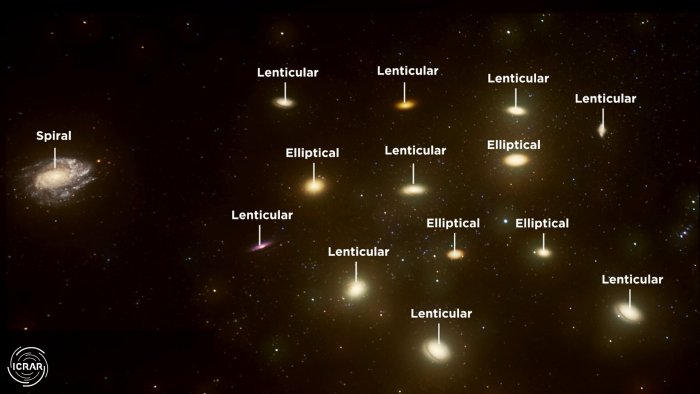
A representation of how the EAGLES program classifies galaxy as assessed by AI. Credit: ICRAR

Astronomers May Have Uncovered How Galaxies Change Their shape

Eddie Gonzales Jr. – MessageToEagle.com – Researchers may have answered a decades-old question about galaxy evolution, leveraging the power of artificial intelligence (AI) to accelerate their research. Ever since the Hubble Sequence, that classifies galaxy morphologies, was invented in 1926, astronomers have been refining our understanding of galaxy evolution and morphology as our technology advances.

Astronomers May Have Uncovered How Galaxies Change Their shape Read More »

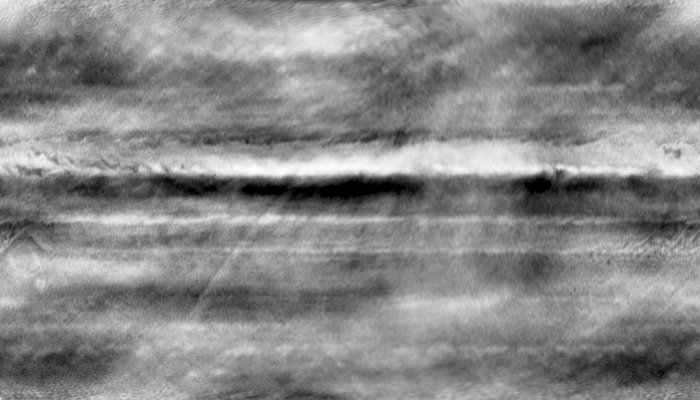
Detail from a VLA image of Jupiter made in conjunction with observations by the Juno spacecraft in orbit around that planet. Credit: Moeckel, et al., Bill Saxton, NRAO/AUI/NSF

VLA And ALMA Study Jupiter And Io That Can Solve Some Mysteries Of Our Own Solar System

Eddie Gonzales Jr. – MessageToEagle.com – While the National Science Foundation’s Karl G. Jansky Very Large Array (VLA) and the Atacama Large Millimeter/submillimeter Array (ALMA) frequently reveal important new facts about objects far beyond our own Milky Way Galaxy—at distances of many millions or billions of light-years—they also are vital tools for unraveling much closer

VLA And ALMA Study Jupiter And Io That Can Solve Some Mysteries Of Our Own Solar System Read More »

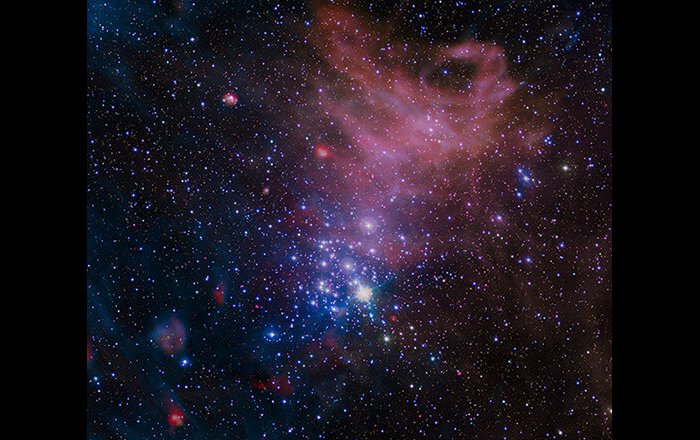
Credit: X-ray: NASA/CXC/Penn State Univ./K. Getman et al.; Infrared: ESA/NASA JPL-Caltech/Herschel Space Observatory/JPL/IPAC; NASA JPL-Caltech/SSC/Spitzer Space Telescope; Optical: MPG/ESO/G. Beccari

Most Extensive Study Yet Of Young Stars’ Magnetic Activity

Eddie Gonzales Jr. – MessageToEagle.com – Astronomers have made the most extensive study yet of how magnetically active stars are when they are young. This gives scientists a window into how X-rays from stars like the sun, but billions of years younger, could partially or completely evaporate the atmospheres of planets orbiting them. Credit: X-ray:

Most Extensive Study Yet Of Young Stars’ Magnetic Activity Read More »

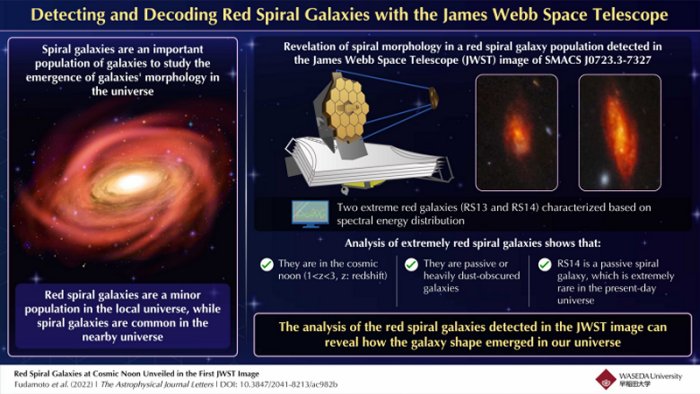
Discovering a rare red spiral galaxy population from the early universe with the James Webb Space Telescope

Discovering A Rare Red Spiral Galaxy Population From Early Universe With JWST

Eddie Gonzales Jr. – MessageToEagle.com – Spiral galaxies represent one of the most spectacular features in our universe. Among them, spiral galaxies in the distant universe contain significant information about their origin and evolution. However, we have had a limited understanding of these galaxies due to them being too distant to study in detail. Graphical

Discovering A Rare Red Spiral Galaxy Population From Early Universe With JWST Read More »

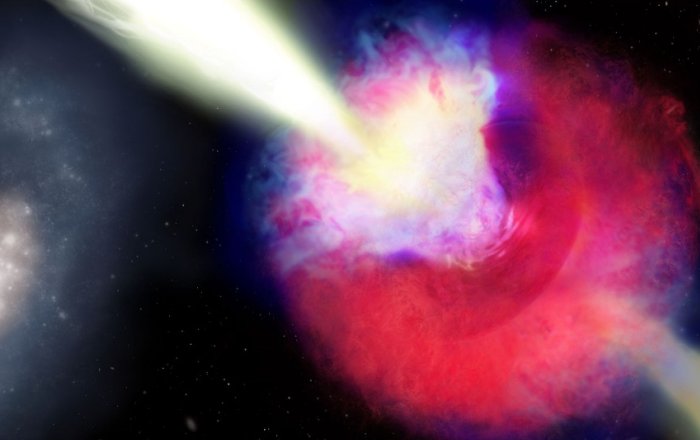
Artist’s impression of GRB 211211A. The kilonova and gamma-ray burst is on the right. The blue color represents material squeezed along the poles, while the red colors indicate material ejected by the two inspiralling neutron stars that is now swirling around the merged object. A disk of ejecta emitted after the merger, hidden behind the red and blue ejecta, is shown in purple. A fast jet (shown in yellow) of material punches through the kilonova cloud. The event occurred about 8 kiloparsecs from its host galaxy (left). Credit: Aaron M. Geller/Northwestern/CIERA and IT Research Computing Services.

Surprise Kilonova Upends Established Understanding Of Long Gamma-Ray Bursts

Eddie Gonzales Jr. – MessageToEagle.com – For nearly two decades, astrophysicists have believed that long gamma-ray bursts (GRBs) resulted solely from the collapse of massive stars. Now, a new study upends that long-established and long-accepted belief. Led by Northwestern University, a team of astrophysicists has uncovered new evidence that at least some long GRBs also

Surprise Kilonova Upends Established Understanding Of Long Gamma-Ray Bursts Read More »

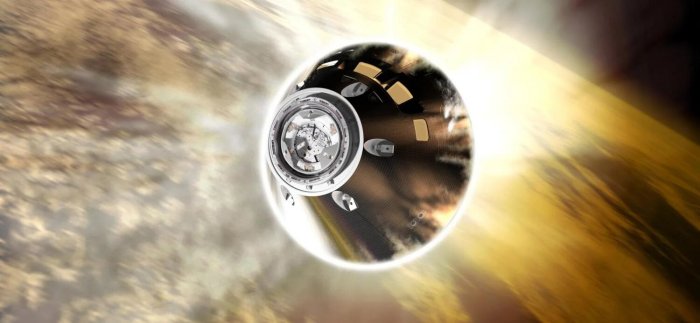
Artist's depiction of the Orion capsule reentering Earth's atmosphere. Credit: NASA

NASA Spacecraft Will Soon Enter Earth’s Atmosphere At Nearly 25,000 mph – What Will Happen Next?

Eddie Gonzales Jr. – MessageToEagle.com – Sunday at around 10:40 a.m. MT, NASA’s Orion spacecraft will splash down in the Pacific Ocean after its several week-long journey to the moon and back. Space buffs can tune into NASA’s livestream to witness some extreme physics—what will be the last leg of the historic Artemis 1 mission,

NASA Spacecraft Will Soon Enter Earth’s Atmosphere At Nearly 25,000 mph – What Will Happen Next? Read More »