Astronomy

Astronomy

Our Universe is amazing and full of cosmic mysteries and curious anomalies. Since the dawn of history, humans have gazed at the night sky and wondered what is really out there. Where can we find extraterrestrials? What would alien worlds look like? There is still so much we don’t know about the Universe.

In this section, we take you on a journey to distant worlds and explore the secrets of our universe. You’ll find here the latest astronomy news, remarkable facts about the cosmos and space mysteries scientists are still trying to solve.

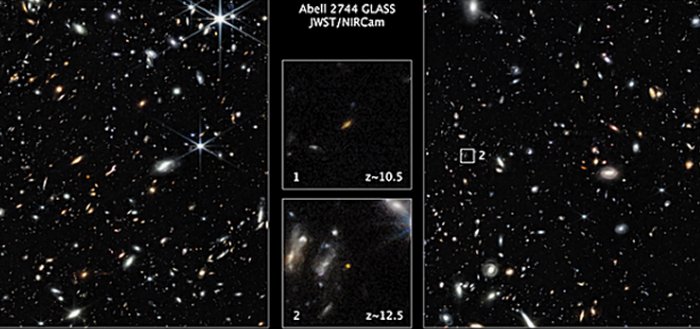
Two exceptionally bright galaxies were captured in GLASS-JWST program. These galaxies existed approximately 450 and 350 million years after the Big Bang (with a redshift of approximately 10.5 and 12.5, respectively), and sizes are roughly 500 parsecs and 170 parsecs, respectively. Credit: NASA, ESA, CSA, Tommaso Treu (UCLA)

Researchers Measure Size-Luminosity Relation Of Galaxies Less Than A Billion Years After Big Bang

Eddie Gonzales Jr. – MessageToEagle.com – An international team of researchers including the Kavli Institute for the Physics and Mathematics of the Universe (Kavli IPMU) has studied the relation between galaxy size and luminosity of some of the earliest galaxies in the universe taken by the brand-new James Webb Space Telescope (JWST), less than a
Researchers Measure Size-Luminosity Relation Of Galaxies Less Than A Billion Years After Big Bang Read More »

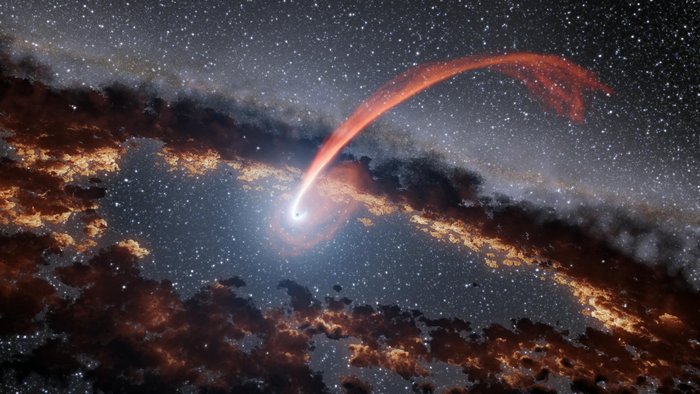
This illustration shows a glowing stream of material from a star as it is being devoured by a supermassive black hole in a tidal disruption flare. When a star passes within a certain distance of a black hole - close enough to be gravitationally disrupted - the stellar material gets stretched and compressed as it falls into the black hole. Credit: NASAJPL-Caltech

A Star’s Unexpected Survival

Eddie Gonzales Jr. – MessageToEagle.com – A team of physicists devises a model that maps a star’s surprising orbit about a supermassive black hole – revealing new information about one of the cosmos’ most extreme. Hundreds of millions of light-years away in a distant galaxy, a star orbiting a supermassive black hole is being violently

A Star’s Unexpected Survival Read More »

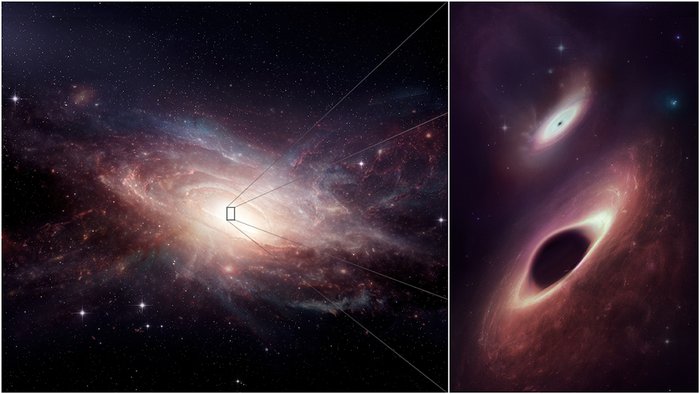
This artist’s conception shows a late-stage galaxy merger and its two newly-discovered central black holes. The binary black holes are the closest together ever observed in multiple wavelengths. Credit: ALMA (ESO/NAOJ/NRAO); M. Weiss, NRAO/AUI/NSF

Doomed Pair Of ‘Goliath’ Black Holes The Closest To Collision Ever Seen

Eddie Gonzales Jr. – MessageToEagle.com – New observations and analysis by Flatiron Institute researchers and their colleagues reveal two Goliath black holes just 750 light-years apart and closing, as they circle each other in the aftermath of a galaxy merger. This artist’s conception shows a late-stage galaxy merger and its two newly-discovered central black holes.

Doomed Pair Of ‘Goliath’ Black Holes The Closest To Collision Ever Seen Read More »

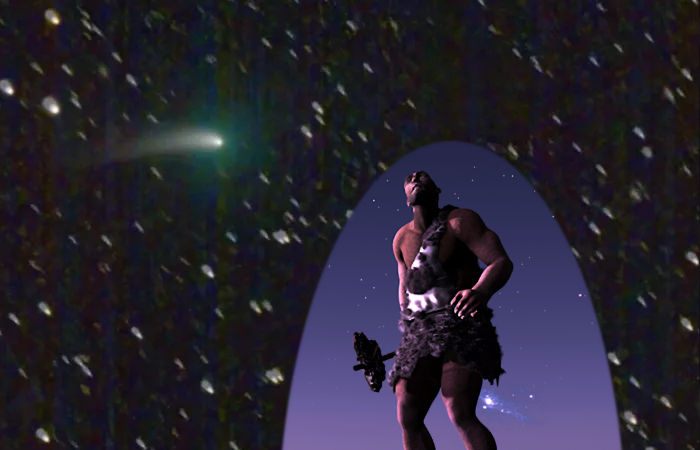
Green Comet Last Seen By The Neanderthals 50,000 Yeas Ago May Be Visible To The Naked Eye This Week

Green Comet Last Seen By The Neanderthals 50,000 Years Ago May Be Visible To The Naked Eye This Week

Eddie Gonzales Jr. – MessageToEagle.com – The last time comet named C/2022 E3 (ZTF) was spotted was during the Upper Paleolithic period. Our distant relatives, the Neanderthals, watched the comet pass the Earth, but they wouldn’t have known what C/2022 E3 (ZTF) was. Maybe the early homo sapiens alive during the last glacial period or the

Green Comet Last Seen By The Neanderthals 50,000 Years Ago May Be Visible To The Naked Eye This Week Read More »

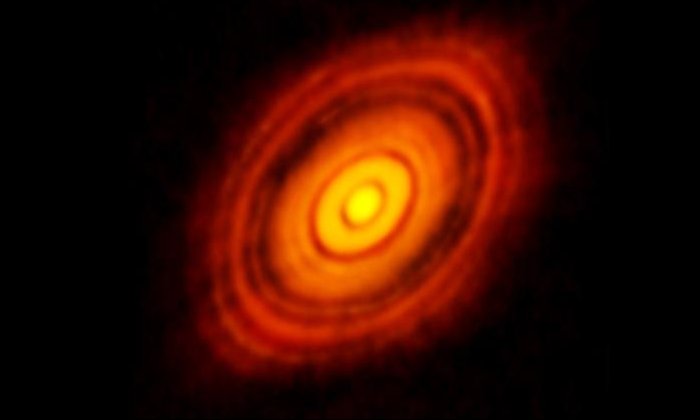
ALMA image of the protoplanetary disc around HL Tauri Credit: ALMA (ESO/NAOJ/NRAO)

‘Little Hurricanes’ Used To Weigh And Date Planets Around Young Stars

Eddie Gonzales Jr. – MessageToEagle.com – Little ‘hurricanes’ that form in the discs of gas and dust around young stars can be used to study certain aspects of planet formation, even for smaller planets which orbit their star at large distances and are out of reach for most telescopes. ALMA image of the protoplanetary disc

‘Little Hurricanes’ Used To Weigh And Date Planets Around Young Stars Read More »

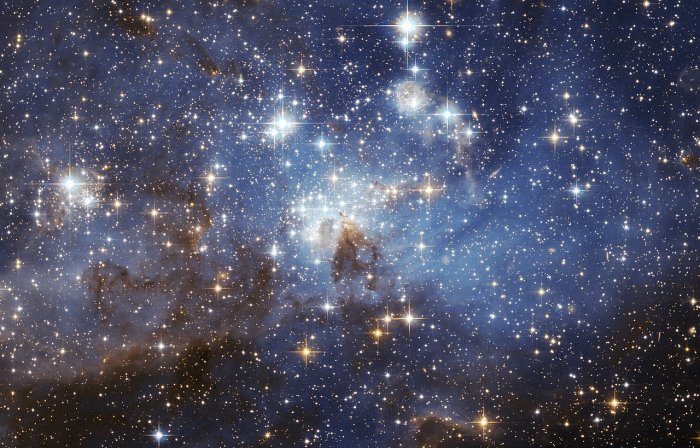
A star-forming region in the Large Magellanic Cloud

When Stars Are No Longer Born: The Challenge Of The New ERC Red Cardinal Project

Eddie Gonzales Jr. – MessageToEagle.com – The unprecedented observations of the James Webb Space Telescope are now combined with the research challenge of a new ERC project to shed light on a still mysterious phase in the history of the Universe: the extinction of the ability to form new stars that occurs during the evolution of

When Stars Are No Longer Born: The Challenge Of The New ERC Red Cardinal Project Read More »

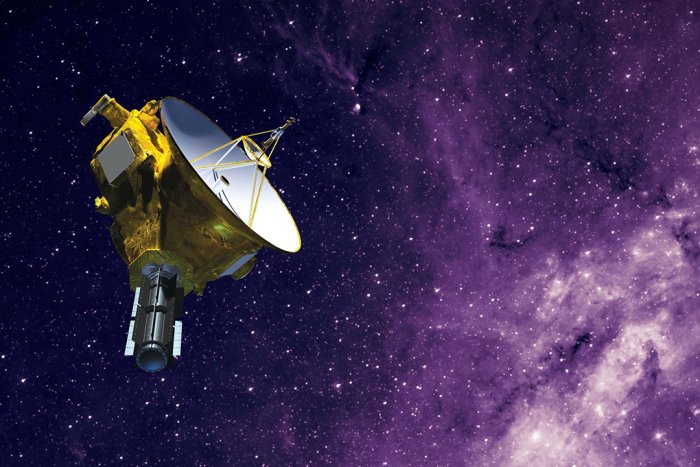
Artist's impression of NASA's New Horizons spacecraft. NASA/APL/SwRI and NASA/JPL-Caltech

Light From Outside Our Galaxy Brighter Than Expected – New Study

Eddie Gonzales Jr. – MessageToEagle.com – Scientists analyzed new measurements showing that the light emitted by stars outside our galaxy is two to three times brighter than the light from known populations of galaxies, challenging assumptions about the number and environment of stars are in the universe. Study led by RIT scientists uses data taken by

Light From Outside Our Galaxy Brighter Than Expected – New Study Read More »

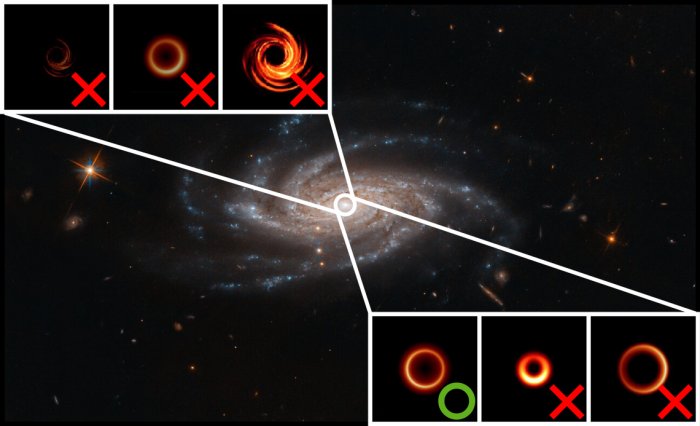
How it works: Using trial and error, machine learning tests many different pairings of simulated galaxies and black holes created using different rules, and then chooses the pairing that best matches actual astronomical observations.H. Zhang, Wielgus et al. (2020), ESA/Hubble & NASA, A. Bellini

Computer-Generated “Universes”: Machine Learning Reveals How Black Holes Grow

Eddie Gonzales Jr. – MessageToEagle.com – University of Arizona researchers created simulations of millions of computer-generated “universes” to test astrophysical predictions that have eluded astronomical observations. How it works: Using trial and error, machine learning tests many different pairings of simulated galaxies and black holes created using different rules, and then chooses the pairing that

Computer-Generated “Universes”: Machine Learning Reveals How Black Holes Grow Read More »