Astronomy

Astronomy

Our Universe is amazing and full of cosmic mysteries and curious anomalies. Since the dawn of history, humans have gazed at the night sky and wondered what is really out there. Where can we find extraterrestrials? What would alien worlds look like? There is still so much we don’t know about the Universe.

In this section, we take you on a journey to distant worlds and explore the secrets of our universe. You’ll find here the latest astronomy news, remarkable facts about the cosmos and space mysteries scientists are still trying to solve.

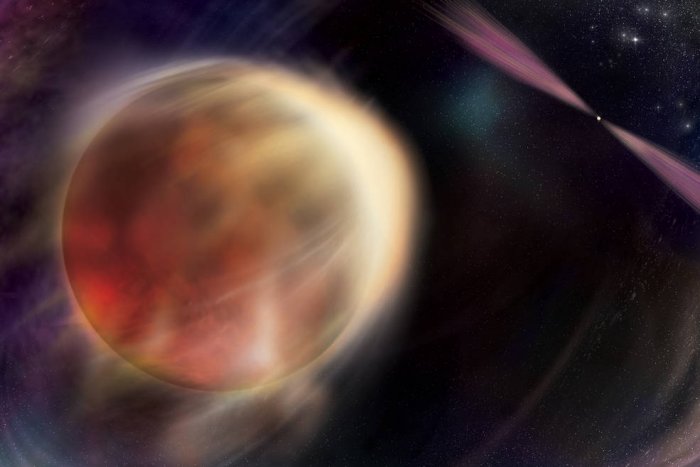
An orbiting star begins to eclipse its partner, a rapidly rotating, superdense stellar remnant called a pulsar, in this illustration. The pulsar emits multiwavelength beams of light that rotate in and out of view and produces outflows that heat the star’s facing side, blowing away material and eroding its partner. Credits: NASA/Sonoma State University, Aurore Simonnet

NASA’s Fermi Detects First Gamma-Ray Eclipses From ‘Spider’ Star Systems

Eddie Gonzales Jr. – MessageToEagle.com – Scientists have discovered the first gamma-ray eclipses from a special type of binary star system using data from NASA’s Fermi Gamma-ray Space Telescope. These so-called spider systems each contain a pulsar – the superdense, rapidly rotating remains of a star that exploded in a supernova – that slowly erodes

NASA’s Fermi Detects First Gamma-Ray Eclipses From ‘Spider’ Star Systems Read More »

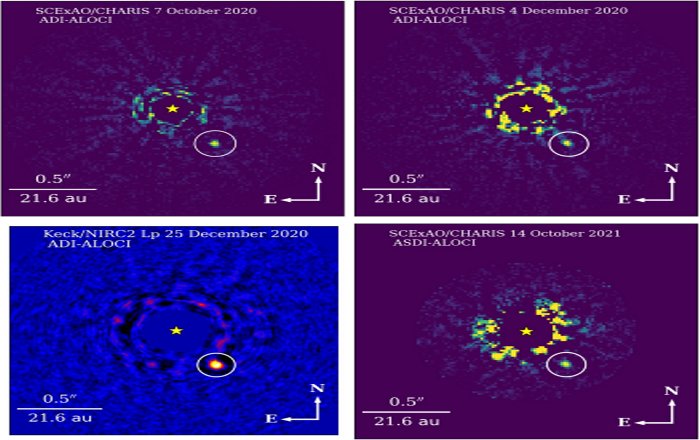
First Confirmed Direct Image Of A Brown Dwarf Orbiting A Star In The Hyades Cluster

First Confirmed Direct Image Of A Brown Dwarf Orbiting A Star In The Hyades Cluster

Eddie Gonzales Jr. – MessageToEagle.com – A team of astronomers using two Maunakea Observatories in Hawai?i – W. M. Keck Observatory and Subaru Telescope – have photographed a brown dwarf orbiting HIP 21152, a young Sun-like star in the Hyades Cluster. Four direct images of the brown dwarf HIP 21152 B captured using the Subaru

First Confirmed Direct Image Of A Brown Dwarf Orbiting A Star In The Hyades Cluster Read More »

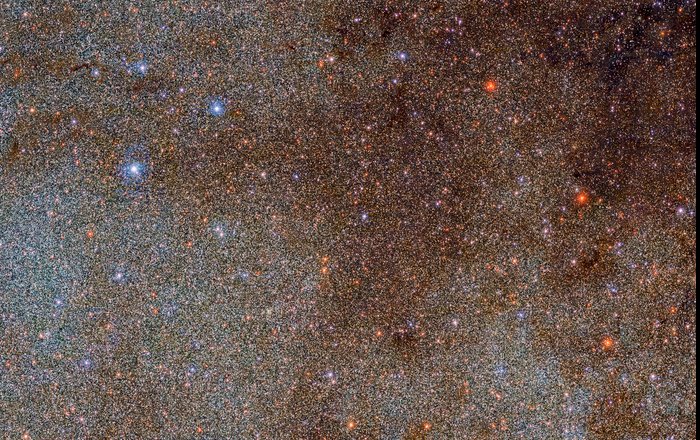
Catalog With 3.32 Billion Celestial Objects - A Gargantuan Survey Of The Galactic Plane Of The Milky Way -

Catalog With 3.32 Billion Celestial Objects – A Colossal Survey Of The Galactic Plane Of The Milky Way –

Eddie Gonzales Jr. – MessageToEagle.com – Colossal astronomical data tapestry displays the majesty of our Milky Way in unprecedented detail – a new study. Astronomers have released a gargantuan survey of the galactic plane of the Milky Way. The new dataset contains a staggering 3.32 billion celestial objects — arguably the largest such catalog so

Catalog With 3.32 Billion Celestial Objects – A Colossal Survey Of The Galactic Plane Of The Milky Way – Read More »

Light Pollution Impact 1—From excellent dark sky (left) to inner city sky (right). Credit: NOIRLab/NSF/AURA, P. Marenfeld

Visibility Of Stars In The Night Sky Declines Faster Than Previously Thought

Eddie Gonzales Jr. – MessageToEagle.com – People around the world are seeing fewer and fewer stars in the night sky. The change in star visibility can be explained by an increase in the sky brightness of 7-10 percent per year. The rate of change is faster than satellite measurements of artificial light emissions on Earth

Visibility Of Stars In The Night Sky Declines Faster Than Previously Thought Read More »

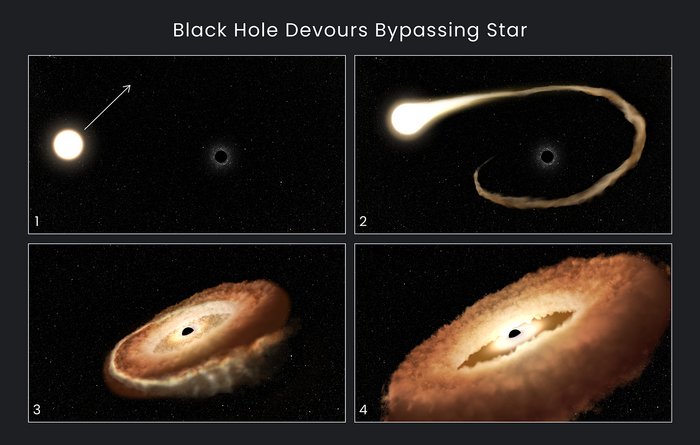
This sequence of artist's illustrations shows how a black hole can devour a bypassing star. 1. A normal star passes near a supermassive black hole in the center of a galaxy. 2. The star's outer gasses are pulled into the black hole's gravitational field. 3. The star is shredded as tidal forces pull it apart. 4. The stellar remnants are pulled into a donut-shaped ring around the black hole, and will eventually fall into the black hole, unleashing a tremendous amount of light and high-energy radiation

Hubble Finds Hungry Black Hole Twisting Captured Star Into Donut Shape

Eddie Gonzales Jr. – MessageToEagle.com – Black holes are gatherers, not hunters. They lie in wait until a hapless star wanders by. When the star gets close enough, the black hole’s gravitational grasp violently rips it apart and sloppily devours its gasses while belching out intense radiation. This sequence of artist’s illustrations shows how a

Hubble Finds Hungry Black Hole Twisting Captured Star Into Donut Shape Read More »

An Orbitrap cell.

New Small Laser Device Can Help Detect Life Signs On Other Planets

Eddie Gonzales Jr. – MessageToEagle.com – UMD-led team developed a miniaturized analyzer that may revolutionize how astrobiology discoveries are made on faraway moons and planets. As space missions delve deeper into the outer solar system, the need for more compact, resource-conserving and accurate analytical tools has become increasingly critical—especially as the hunt for extraterrestrial life

New Small Laser Device Can Help Detect Life Signs On Other Planets Read More »

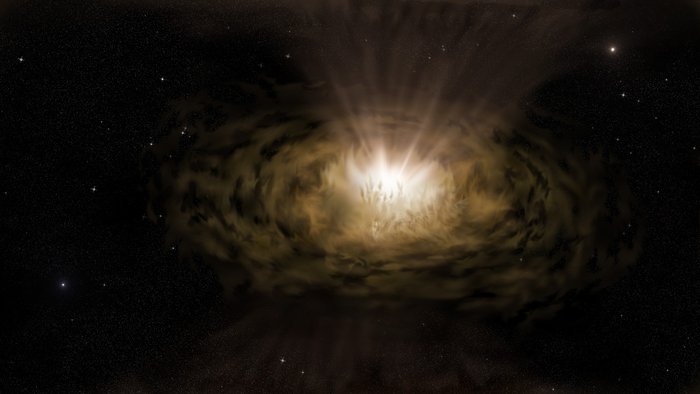
An artist’s impression of what the dust around an active galactic nucleus might look like seen from a light year away.

Active Galactic Nuclei Are Even More Powerful Than Thought – New Study

Eddie Gonzales Jr. – MessageToEagle.com – Powered by supermassive black holes swallowing matter in the centers of galaxies, active galactic nuclei are the most powerful compact steady sources of energy in the universe. The brightest active galactic nuclei have long been known to far outshine the combined light of the billions of stars in their

Active Galactic Nuclei Are Even More Powerful Than Thought – New Study Read More »