Astronomy

Astronomy

Our Universe is amazing and full of cosmic mysteries and curious anomalies. Since the dawn of history, humans have gazed at the night sky and wondered what is really out there. Where can we find extraterrestrials? What would alien worlds look like? There is still so much we don’t know about the Universe.

In this section, we take you on a journey to distant worlds and explore the secrets of our universe. You’ll find here the latest astronomy news, remarkable facts about the cosmos and space mysteries scientists are still trying to solve.

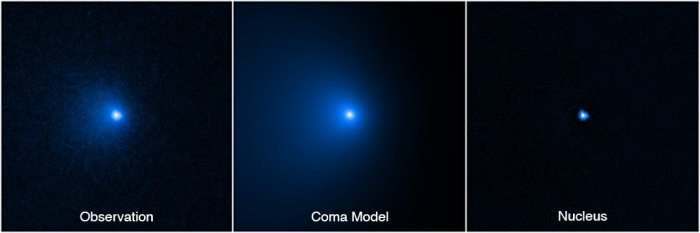
This sequence shows how the nucleus of Comet C/2014 UN271 (Bernardinelli-Bernstein) was isolated from a vast shell of dust and gas surrounding the solid icy nucleus. On the left is a photo of the comet taken by the NASA Hubble Space Telescope's Wide Field Camera 3 on January 8, 2022. A model of the coma (middle panel) was obtained by means of fitting the surface brightness profile assembled from the observed image on the left. This allowed for the coma to be subtracted, unveiling the point-like glow from the nucleus. Combined with radio telescope data, astronomers arrived at a precise measurement of the nucleus size. That's no small feat from something about 2 billion miles away. Though the nucleus is estimated to be as large as 85 miles across, it is so far away it cannot be resolved by Hubble. Its size is derived from its reflectivity as measured by Hubble. The nucleus is estimated to be as black as charcoal. The nucleus area is gleaned from radio observations. Credit: NASA, ESA, Man-To Hui (Macau University of Science and Technology), David Jewitt (UCLA)Image Processing: Alyssa Pagan (STScI)

4 Billion-Year-Old Gigantic Relic From Early Solar System Heading Our Way

Eddie Gonzales Jr. – MessageToEagle.com – An enormous comet—approximately 80 miles across, more than twice the width of Rhode Island—is heading our way at 22,000 miles per hour from the edge of the solar system. Fortunately, it will never get closer than 1 billion miles from the sun, which is slightly farther from Earth than

4 Billion-Year-Old Gigantic Relic From Early Solar System Heading Our Way Read More »
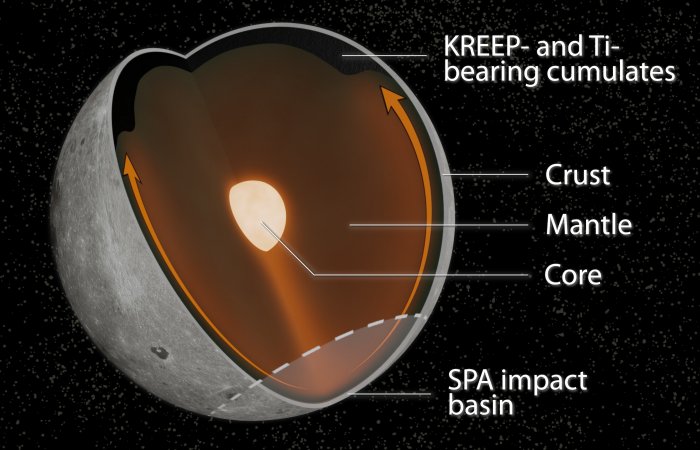
A new study reveals that an ancient collision on the Moon's south pole changed patterns of convection in the lunar mantle, concentrating a suite of heat-producing elements on the nearside. Those elements played a role in creating the vast lunar mare visible from Earth. Credit: Matt Jones

Differences Between The Moon’s Near And Far Sides Linked To Colossal Ancient Impact

Eddie Gonzales Jr. – MessageToEagle.com – The face that the Moon shows to Earth looks far different from the one it hides on its far side. The nearside is dominated by the lunar mare—the vast, dark-colored remnants of ancient lava flows. The crater-pocked far side, on the other hand, is virtually devoid of large-scale mare

Differences Between The Moon’s Near And Far Sides Linked To Colossal Ancient Impact Read More »

Universe

Ten New Gravitational Waves Found In LIGO-Virgo’s O3a Data

Eddie Gonzales Jr. – MessageToEagle.com – In the last seven years, scientists at the LIGO-Virgo Collaboration (LVC) have detected 90 gravitational waves signals. Gravitational waves are perturbations in the fabric of spacetime that race outwards from cataclysmic events like the merger of binary black holes (BBH). In observations from the first half of the most

Ten New Gravitational Waves Found In LIGO-Virgo’s O3a Data Read More »

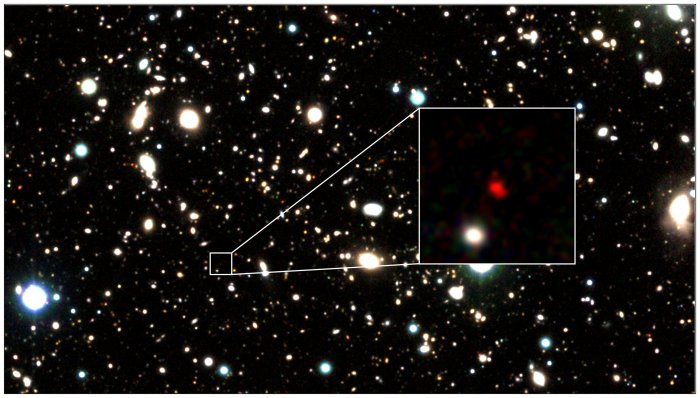
galaxy candidate is some 13.5 billion light-years away and is described Thursday in the Astrophysical Journal. In an accompanying paper published in the Monthly Notices of the Royal Astronomical Society Letters, scientists have begun to speculate exactly what the galaxy is. The team proposes two ideas: HD1 may be forming stars at an astounding rate and is possibly even home to Population III stars, the universe's very first stars—which, until now, have never been observed. Alternatively, HD1 may contain a supermassive black hole about 100 million times the mass of our Sun. "Answering questions about the nature of a source so far away can be challenging," says Fabio Pacucci, lead author of the MNRAS study, co-author in the discovery paper on ApJ, and an astronomer at the Center for Astrophysics. "It's like guessing the nationality of a ship from the flag it flies, while being faraway ashore, with the vessel in the middle of a gale and dense fog. One can maybe see some colors and shapes of the flag, but not in their entirety. It's ultimately a long game of analysis and exclusion of implausible scenarios." HD1 is extremely bright in ultraviolet light. To explain this, "some energetic processes are occurring there or, better yet, did occur some billions of years ago," Pacucci says. At first, the researchers assumed HD1 was a standard starburst galaxy, a galaxy that is creating stars at a high rate. But after calculating how many stars HD1 was producing, they obtained "an incredible rate—HD1 would be forming more than 100 stars every single year. This is at least 10 times higher than what we expect for these galaxies." That's when the team began suspecting that HD1 might not be forming normal, everyday stars. "The very first population of stars that formed in the universe were more massive, more luminous and hotter than modern stars," Pacucci says. "If we assume the stars produced in HD1 are these first, or Population III, stars, then its properties could be explained more easily. In fact, Population III stars are capable of producing more UV light than normal stars, which could clarify the extreme ultraviolet luminosity of HD1." Timeline displays the earliest galaxy candidates and the history of the universe. Credit: Harikane et al., NASA, EST and P. Oesch/Yale. A supermassive black hole, however, could also explain the extreme luminosity of HD1. As it gobbles down enormous amounts of gas, high energy photons may be emitted by the region around the black hole. If that's the case, it would be by far the earliest supermassive black hole known to humankind, observed much closer in time to the Big Bang compared to the current record-holder. "HD1 would represent a giant baby in the delivery room of the early universe," says Avi Loeb an astronomer at the Center for Astrophysics and co-author on the MNRAS study. "It breaks the highest quasar redshift on record by almost a factor of two, a remarkable feat." HD1 was discovered after more than 1,200 hours of observing time with the Subaru Telescope, VISTA Telescope, UK Infrared Telescope and Spitzer Space Telescope. "It was very hard work to find HD1 out of more than 700,000 objects," says Yuichi Harikane, an astronomer at the University of Tokyo who discovered the galaxy. "HD1's red color matched the expected characteristics of a galaxy 13.5 billion light-years away surprisingly well, giving me a little bit of goosebumps when I found it." The team then conducted follow-up observations using the Atacama Large Millimeter/submillimeter Array (ALMA) to confirm the distance, which is 100 million light years further than GN-z11, the current record-holder for the furthest galaxy. Using the James Webb Space Telescope, the research team will soon once again observe HD1 to verify its distance from Earth. If current calculations prove correct, HD1 will be the most distant—and oldest—galaxy ever recorded. The same observations will allow the team to dig deeper into HD1's identity and confirm if one of their theories is correct. "Forming a few hundred million years after the Big Bang, a black hole in HD1 must have grown out of a massive seed at an unprecedented rate," Loeb says. "Once again, nature appears to be more imaginative than we are." Explore further Astronomers confront massive black hole at the heart of the Milky Way, Sagittarius A* More information: A Search for H-Dropout Lyman Break Galaxies at z~12-16, arXiv:2112.09141 [astro-ph.GA] arxiv.org/abs/2112.09141 , Accepted for publication in MNRAS Letters. Are the newly-discovered z∼13 drop-out sources starburst galaxies or quasars?, arXiv:2201.00823 [astro-ph.GA] arxiv.org/abs/2201.00823 , Accepted for publication in ApJ. Journal information: Astrophysical Journal , Monthly Notices of the Royal Astronomical Society Letters , Monthly Notices of the Royal Astronomical Society Provided by Harvard-Smithsonian Center for Astrophysics Facebook Twitter Email Feedback to editors Featured Last Comments Popular Megathrust earthquake and tsunami 3,800 years ago kept hunter-gathers in Chile inland for 1,000 years 4 HOURS AGO 1 Identifying the basic structure of the language of fungi 6 HOURS AGO 0 Two new Saturn-mass exoplanets discovered 6 HOURS AGO 1 Astronomers inspect nova T Aurigae with Hubble APR 06, 2022 1 Astrophysicists theorize a new type of neutron star APR 06, 2022 1 Team develops a universal AI algorithm for in-depth cleaning of single cell genomic data 5 MINUTES AGO Engineers describe how fluid suspensions exhibit different behaviors at different scales 50 MINUTES AGO Researchers develop glass-in-glass fabrication approach for making miniature IR optics 50 MINUTES AGO Research team unlocks new method to 3D-print complex, functional components for soft robotics 1 HOUR AGO World's largest International Dark Sky Reserve created 1 HOUR AGO Researchers engineer electrically tunable graphene devices to study rare physics 1 HOUR AGO Research shows 'raised without antibiotics' label claim in beef cattle lacks integrity 1 HOUR AGO Relevant PhysicsForums posts Does there exist a metal that is 100% unrustable? 33 MINUTES AGO B: Calculate the distance between two points without using a coordinate system 35 MINUTES AGO Site feedback 39 MINUTES AGO De Laval nozzle exit pressure 58 MINUTES AGO Random Thoughts part 6 1 HOUR AGO Chernobyl loses power, spent fuel storage question #Ukraine 1 HOUR AGO More from Physics Forums | Science Articles, Homework Help, Discussion 1 2 Medical Xpress Medical research advances and health news Tech Xplore The latest engineering, electronics and technology advances Science X The most comprehensive sci-tech news coverage on the web Newsletters Email Science X Daily and the Weekly Email Newsletter are free features that allow you to receive your favorite sci-tech news updates in your email inbox Follow us Top Home Search Mobile version Help FAQ About Contact Science X Account Sponsored Account Archive News wire Android app iOS app RSS feeds Push notification © Phys.org 2003 - 2022 powered by Science X Network Privacy policy Terms of use 1 / 1HD1, object in red, appears at the center of a zoom-in image. Credit: Harikane et al.

Farthest Galaxy Ever 13.5 Billion Light-Years Away – Spotted

Eddie Gonzales Jr. – MessageToEagle.com – An international team of astronomers, including researchers at the Center for Astrophysics | Harvard & Smithsonian, has spotted the most distant astronomical object ever: a galaxy. Named HD1, the galaxy candidate is some 13.5 billion light-years away and is described Thursday in the Astrophysical Journal. In an accompanying paper

Farthest Galaxy Ever 13.5 Billion Light-Years Away – Spotted Read More »

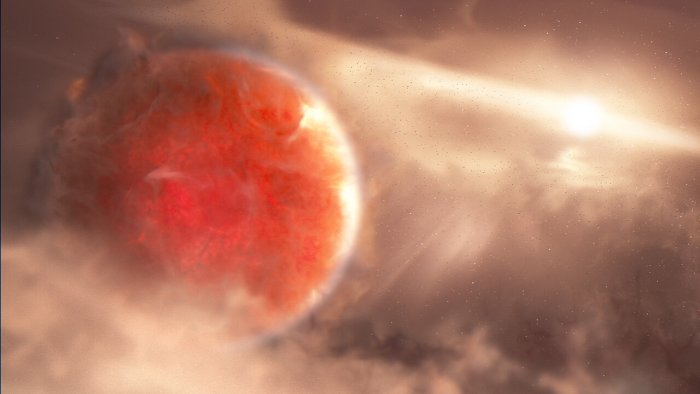
This is an artist's illustration of a massive, newly forming exoplanet called AB Aurigae b. Researchers used new and archival data from the Hubble Space Telescope and the Subaru Telescope to confirm this protoplanet is forming through an intense and violent process, called disk instability. Disk instability is a top-down approach, much different from the dominant core accretion model. In this scenario, a massive disk around a star cools, and gravity causes the disk to rapidly break up into one or more planet-mass fragments. AB Aurigae b is estimated to be about nine times more massive than Jupiter and orbits its host star over two times farther than Pluto is from our Sun. Credit: NASA, ESA, Joseph Olmsted (STScI)

Hubble Finds A Protoplanet That Could Upend Planet Formation Models

Eddie Gonzales Jr. – MessageToEagle.com – NASA’s Hubble Space Telescope has directly photographed evidence of a Jupiter-like protoplanet forming through what researchers describe as an “intense and violent process.” This discovery supports a long-debated theory for how planets like Jupiter form, called “disk instability.” This is an artist’s illustration of a massive, newly forming exoplanet

Hubble Finds A Protoplanet That Could Upend Planet Formation Models Read More »

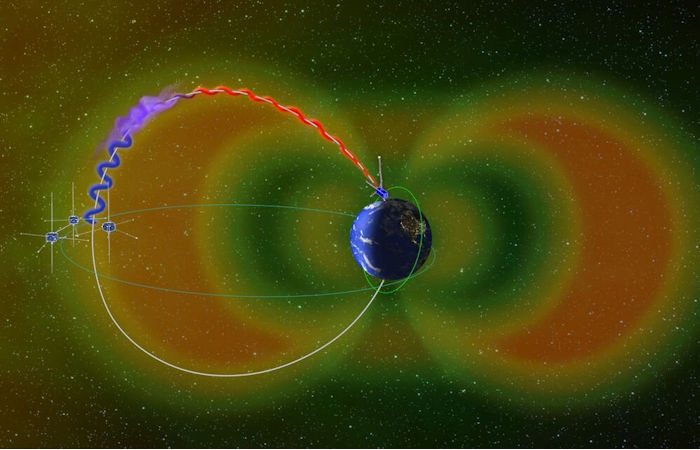
Researchers Discover Source Of Super-Fast Electron Rain

Researchers Discover Source Of Super-Fast Electron Rain

Eddie Gonzales Jr. – MessageToEagle.com – UCLA scientists have discovered a new source of super-fast, energetic electrons raining down on Earth, a phenomenon that contributes to the colorful aurora borealis but also poses hazards to satellites, spacecraft and astronauts. The researchers observed unexpected, rapid “electron precipitation” from low-Earth orbit using the ELFIN mission, a pair

Researchers Discover Source Of Super-Fast Electron Rain Read More »