Astronomy

Astronomy

Our Universe is amazing and full of cosmic mysteries and curious anomalies. Since the dawn of history, humans have gazed at the night sky and wondered what is really out there. Where can we find extraterrestrials? What would alien worlds look like? There is still so much we don’t know about the Universe.

In this section, we take you on a journey to distant worlds and explore the secrets of our universe. You’ll find here the latest astronomy news, remarkable facts about the cosmos and space mysteries scientists are still trying to solve.

New Experiment Gives Insight Into The Chaotic Behavior Of Flows In Planets

New Experiment Gives Insight Into The Chaotic Behavior Of Flows In Planets

Eddie Gonzales Jr. – MessageToEagle.com – Flows in planets like Earth are characterized by many features, such as rotation and the difference in temperature between the hot core and the cold surface. These flows have very large dimensions and it is very hard to investigate them. Image credit: nymixArt – Pixabay To study them, Ph.D.

New Experiment Gives Insight Into The Chaotic Behavior Of Flows In Planets Read More »
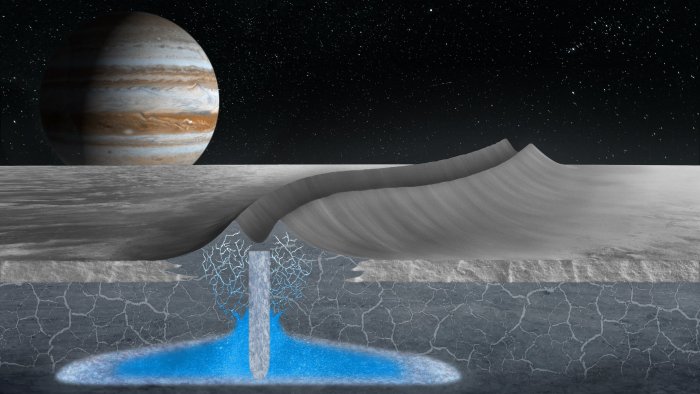
This artist’s conception shows how double ridges on the surface of Jupiter’s moon Europa may form over shallow, refreezing water pockets within the ice shell. This mechanism is based on the study of an analogous double ridge feature found on Earth’s Greenland Ice Sheet. Credit: Justice Blaine Wainwright

Formation Of Abundant Features On Europa Bodes Well For Search For Extraterrestrial Life – Researchers Explain

Eddie Gonzales Jr. – MessageToEagle.com – Europa is a prime candidate for life in our solar system, and its deep saltwater ocean has captivated scientists for decades. But it’s enclosed by an icy shell that could be miles to tens of miles thick, making sampling it a daunting prospect. Now, increasing evidence reveals the ice

Formation Of Abundant Features On Europa Bodes Well For Search For Extraterrestrial Life – Researchers Explain Read More »

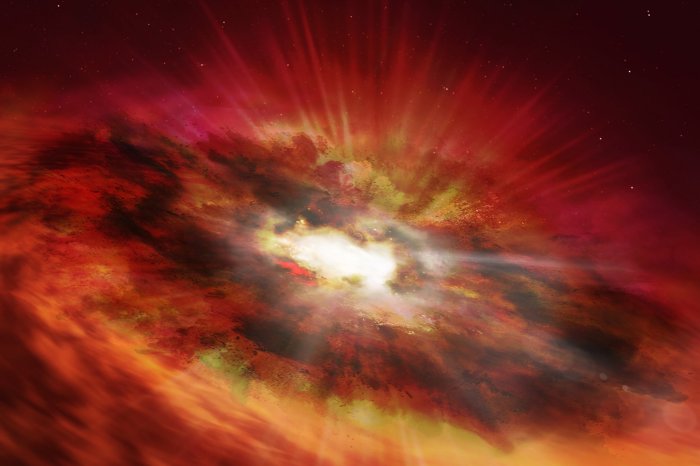
Current theories predict that supermassive black holes begin their lives in the dust-shrouded cores of vigorously star-forming “starburst” galaxies before expelling the surrounding gas and dust and emerging as extremely luminous quasars. Whilst they are extremely rare, examples of both dusty starburst galaxies and luminous quasars have been detected in the early Universe. The team believes that GNz7q could be the “missing link” between these two classes of objects. Credit: ESA/Hubble, N. Bartmann

A Dusty Compact Object Bridging Galaxies And Quasars At Cosmic Dawn

Eddie Gonzales Jr. – MessageToEagle.com – Astrophysicists at the Niels Bohr Institute, University of Copenhagen, and the Technical University of Denmark have identified a distant object with properties that lie between those of a galaxy and those of a so-called quasar. The object can be seen as the ancestor of a supermassive black hole, and

A Dusty Compact Object Bridging Galaxies And Quasars At Cosmic Dawn Read More »

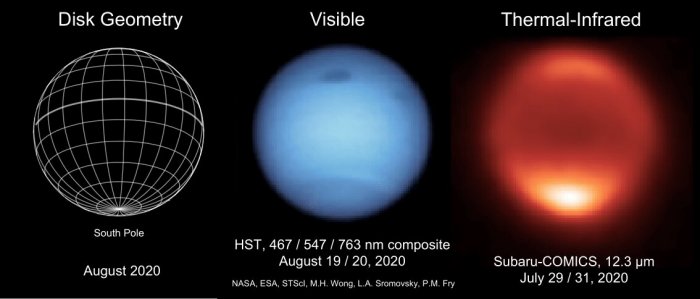
Neptune as seen in visible light (centre) and thermal-infrared wavelengths (right), in 2020. The centre image combines multiple images from the Hubble Space Telescope, while the thermal-infrared image on the right was taken from the Subaru Telescope on Maunakea, Hawai’i. In the thermal-infrared, Neptune’s warm south pole glows more brightly than ever seen before. Credit: Michael Roman/NASA/ESA/STSci/M.H. Wong/L.A. Sromovsky/P.M. Fry

Neptune Is Cooler Than We thought – New Observations

Eddie Gonzales Jr. – MessageToEagle.com – New research led by space scientists at the University of Leicester has revealed how temperatures in Neptune’s atmosphere have unexpectedly fluctuated over the past two decades. In a new study, researchers used observations in thermal-infrared wavelengths beyond the visible light spectrum, effectively sensing heat emitted from the planet’s atmosphere.

Neptune Is Cooler Than We thought – New Observations Read More »

Astronomers Capture Surprising Changes In Neptune's Temperatures

Astronomers Capture Surprising Changes In Neptune’s Temperatures

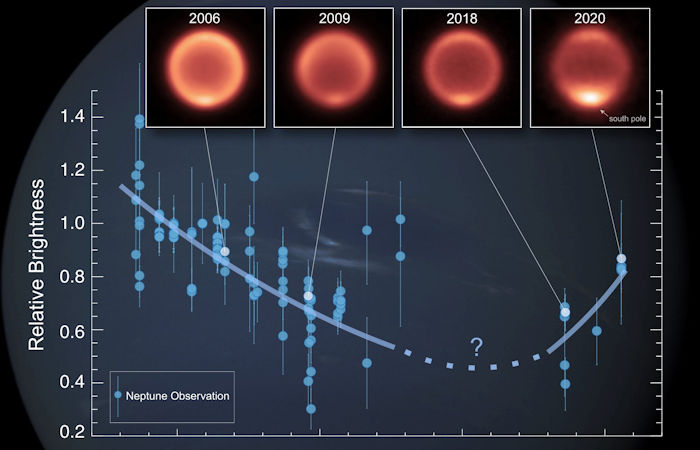
Eddie Gonzales Jr. – MessageToEagle.com – An international team of astronomers has used ground-based telescopes, including the European Southern Observatory’s Very Large Telescope (ESO’s VLT), to track Neptune’s atmospheric temperatures over a 17-year period. They found a surprising drop in Neptune’s global temperatures followed by a dramatic warming at its south pole. This composite shows

Astronomers Capture Surprising Changes In Neptune’s Temperatures Read More »