Astronomy

Astronomy

Our Universe is amazing and full of cosmic mysteries and curious anomalies. Since the dawn of history, humans have gazed at the night sky and wondered what is really out there. Where can we find extraterrestrials? What would alien worlds look like? There is still so much we don’t know about the Universe.

In this section, we take you on a journey to distant worlds and explore the secrets of our universe. You’ll find here the latest astronomy news, remarkable facts about the cosmos and space mysteries scientists are still trying to solve.

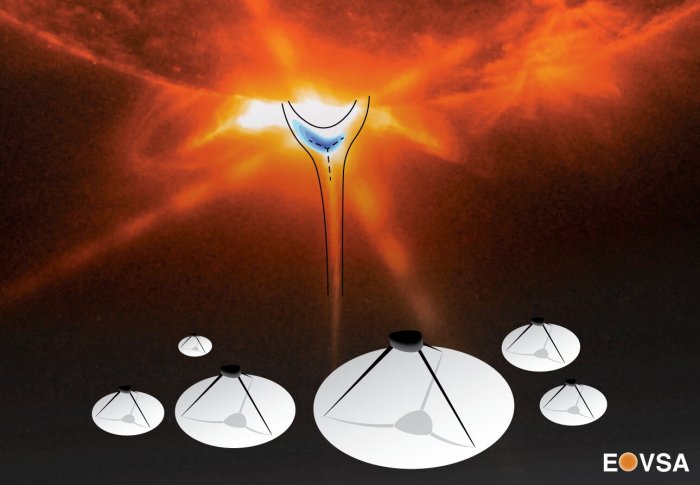
A new study offers the first direct evidence showing where near-light speed particle acceleration occurs inside the largest explosion known in the solar system, the solar flare. Credit: Sijie Yu of NJIT/CSTR; NOAA GOES-16/SUVI

Particle Accelerator Region Inside A Solar Flare – Pinpointed By Researchers

Eddie Gonzales Jr. – MessageToEagle.com – Solar flares are among the most violent explosions in our solar system, but despite their immense energy—equivalent to a hundred billion atomic bombs detonating at once—physicists still haven’t been able to answer exactly how these sudden eruptions on the sun are able to launch particles to Earth, nearly 93

Particle Accelerator Region Inside A Solar Flare – Pinpointed By Researchers Read More »
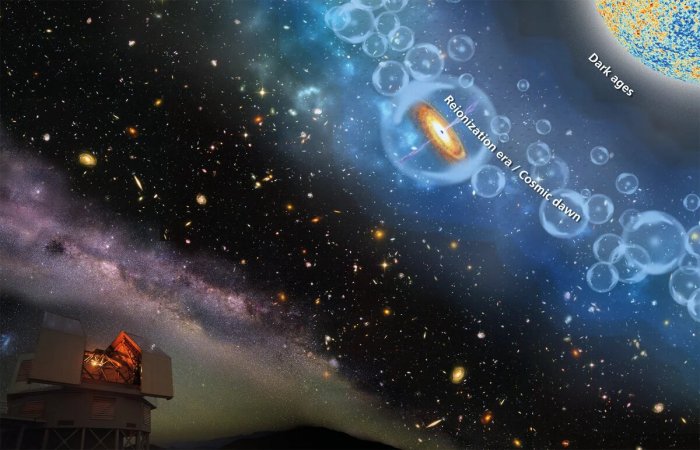
Schematic representation of the view into cosmic history provided by the bright light of distant quasars. Observing with a telescope (bottom left) allows us to gain information about the so-called reionisation epoch (“bubbles” top right) that followed the Big Bang phase (top right). Credit: Carnegie Institution for Science / MPIA (annotations)

Researchers Pinpoint The End Of ‘Cosmic Dawn’ – Epoch Of Reionization

Eddie Gonzales Jr. – MessageToEagle.com – A group of astronomers led by Sarah Bosman from the Max Planck Institute for Astronomy have robustly timed the end of the epoch of reionization of the neutral hydrogen gas to about 1.1 billion years after the Big Bang. Schematic representation of the view into cosmic history provided by

Researchers Pinpoint The End Of ‘Cosmic Dawn’ – Epoch Of Reionization Read More »

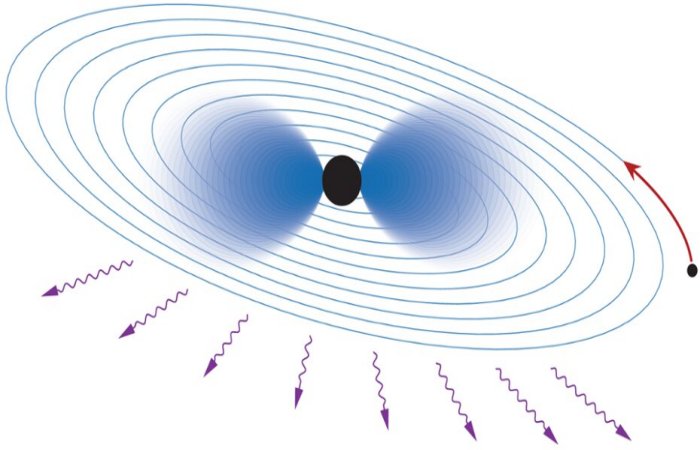
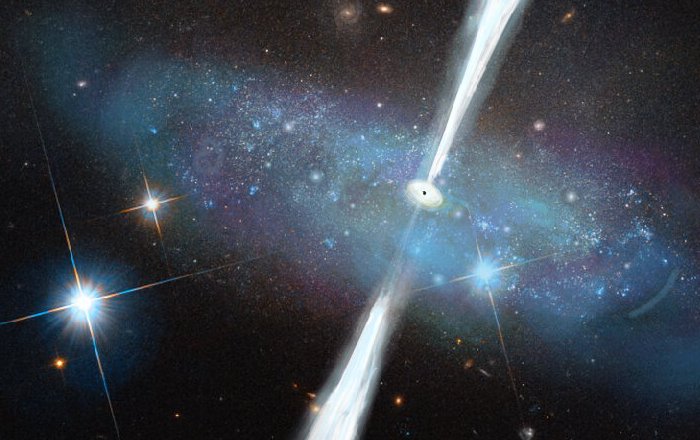
An atom in the sky. If new ultralight particles exist, black holes would be surrounded by a cloud of such particles that behaves surprisingly similar to the cloud of electrons in an atom. When another heavy object spirals in and eventually merges with the black hole, the gravitational atom gets ionized and emits particles just like electrons are emitted when light is shone onto a metal. Credit: UvA Institute of Physics

Detecting New Particles Around Black Holes With Gravitational Waves

Eddie Gonzales Jr. – MessageToEagle.com – Clouds of ultralight particles can form around rotating black holes. A team of physicists from the University of Amsterdam and Harvard University now show that these clouds would leave a characteristic imprint on the gravitational waves emitted by binary black holes. An atom in the sky. If new ultralight

Detecting New Particles Around Black Holes With Gravitational Waves Read More »

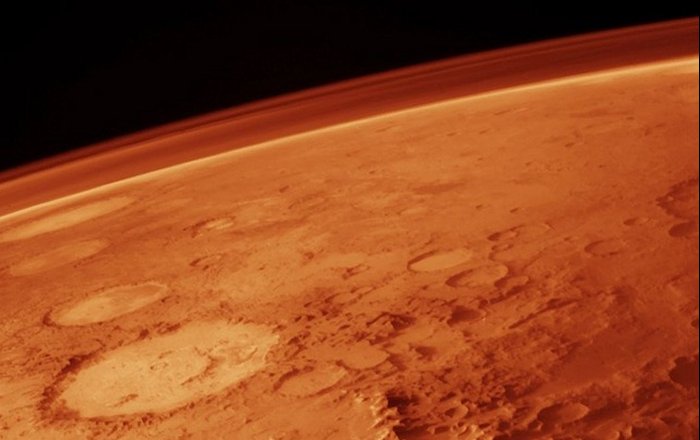
Mars - Red Planet

Breakthrough In Determining Life’s Origin On Earth And Maybe Mars

Eddie Gonzales Jr. – MessageToEagle.com – The first genetic material for life, spontaneously forms on basalt lava glass, and such glass was abundant on Earth 4.35 billion years ago, shows a new study at the Foundation for Applied Molecular Evolution. Ribonucleic acid (RNA), an analog of DNA was likely this material. Similar basalts of this

Breakthrough In Determining Life’s Origin On Earth And Maybe Mars Read More »

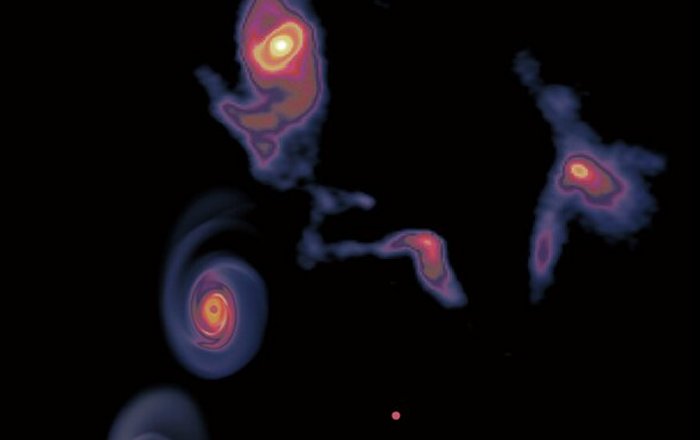
A schematic view of the history of the accretion disk and the intruding object. The three plots starting from the bottom left are snapshots from the numerical simulation, depicting the system at the time of the flyby event, 4000 years later, and 8000 years after that, respectively. The top right image is from the ALMA observations, showing the disk with spirals and two objects around it, corresponding to the system 12,000 years after the flyby event. Credit: SHAO

A Massive Protostellar Disk In Galactic Center – Discovered By Astronomers

Eddie Gonzales Jr. – MessageToEagle.com – Using high-resolution observational data from the Atacama Large Millimeter/submillimeter Array (ALMA), researchers discovered a massive protostellar disk in the Galactic Center to determine how its spiral arms were formed. A schematic view of the history of the accretion disk and the intruding object. The three plots starting from the

A Massive Protostellar Disk In Galactic Center – Discovered By Astronomers Read More »

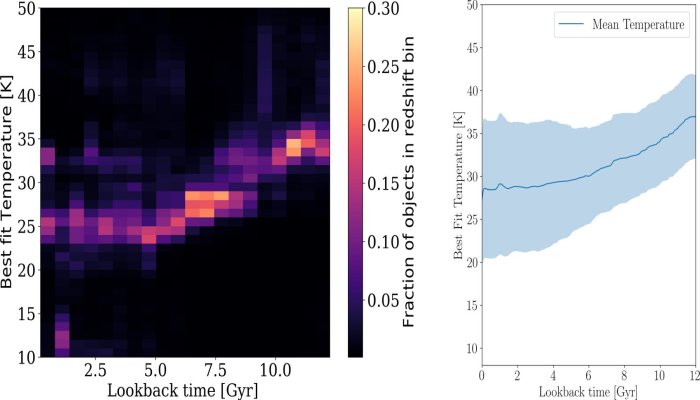
Left: best-fit temperature from 10 to 50 K vs. lookback time from a sample of 139,535 COSMOS2015 galaxies with S/N > 10 in the V band (Laigle et al. 2016). At each redshift, the distribution is individually normalized in order to emphasize the temperature distribution at all redshifts. With increased redshift, fewer galaxies are fit at lower temperatures. Right: boxcar-smoothed mean with standard deviation of best-fit gas temperature at different lookback times (with mean determined from objects in 2 Gyr width age bins and not including galaxies fit at the bounds of temperature range). The mean temperature increases from ∼28 to ∼36 K from present to 12 Gyr, while the spread decreases. Credit: The European Physical Journal E (2022). DOI: 10.1140/epje/s10189-022-00183-5

New Discovery About Distant Galaxies: Stars Are Heavier Than We Thought

Eddie Gonzales Jr. – MessageToEagle.com – For as long as humans have studied the heavens, how stars look in distant galaxies has been a mystery. Now, a team of researchers at the University of Copenhagen’s Niels Bohr Institute is challenging previous understandings of stars beyond our own galaxy. Left: best-fit temperature from 10 to 50

New Discovery About Distant Galaxies: Stars Are Heavier Than We Thought Read More »

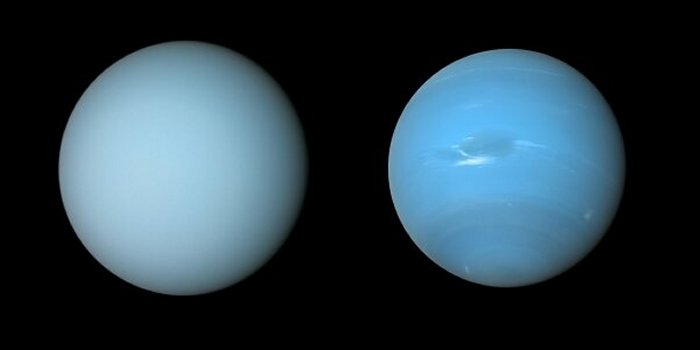
Uranus and Neptune. NASA’s Voyager 2 spacecraft captured these views of Uranus (on the left) and Neptune (on the right) during its flybys of the planets in the 1980s. Credit: NASA/JPL-Caltech/B. Jónsson

Scientists Explain Why Uranus And Neptune Are Different Colors

Eddie Gonzales Jr. – MessageToEagle.com – Observations from Hubble Space Telescope, the NASA Infrared Telescope and the Gemini Observatory, reveal that excess haze on Uranus makes it paler than Neptune and that dark spots are caused by a darkening of a second deeper cloud/haze layer. Uranus and Neptune. NASA’s Voyager 2 spacecraft captured these views

Scientists Explain Why Uranus And Neptune Are Different Colors Read More »