Astronomy

Astronomy

Our Universe is amazing and full of cosmic mysteries and curious anomalies. Since the dawn of history, humans have gazed at the night sky and wondered what is really out there. Where can we find extraterrestrials? What would alien worlds look like? There is still so much we don’t know about the Universe.

In this section, we take you on a journey to distant worlds and explore the secrets of our universe. You’ll find here the latest astronomy news, remarkable facts about the cosmos and space mysteries scientists are still trying to solve.

Longest-Period Exoplanet Found With TESS - Detected And Validated

Longest-Period Exoplanet Found With TESS – Detected And Validated

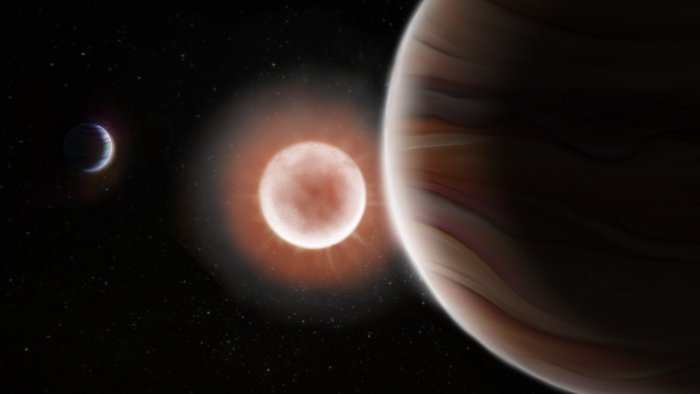
Eddie Gonzales Jr. – MessageToEagle.com – Scientists from The University of New Mexico (UNM), and Massachusetts Institute of Technology (MIT) have detected and validated two of the longest-period exoplanets found by TESS to date. An artist’s rendition of the two planets and star in the TOI-4600 system. Image source These long period large exoplanets orbit

Longest-Period Exoplanet Found With TESS – Detected And Validated Read More »

A Strongly Magnetic Wolf-Rayet Star Is Expected To Produce A Magnetar

Powerful Magnetic Wolf-Rayet Star Is Expected To Produce A Magnetar When It Explodes As A Supernova

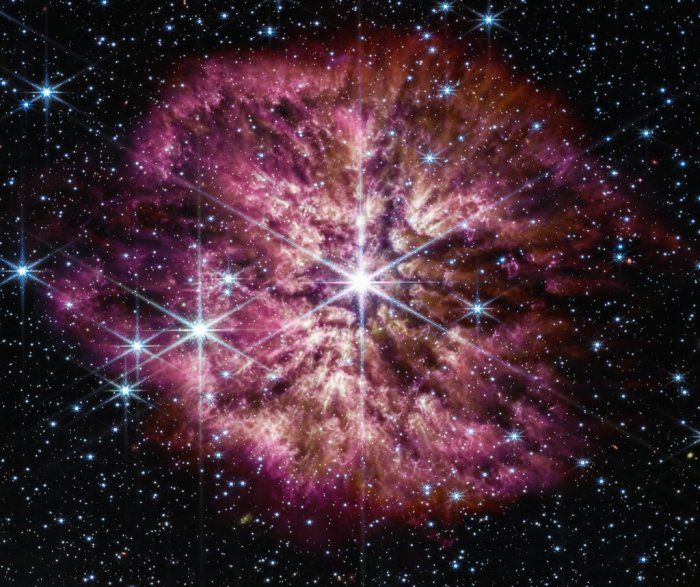
Eddie Gonzales Jr. – MessageToEagle.com – Astronomers say that their observations and stellar-evolution models indicate that the Wolf-Rayet component could be an immediate progenitor of a magnetar. James Webb Space Telescope image of the Wolf–Rayet star WR 124 and the nebula M1–67 surrounding it. NIRCam and MIRI composite. NASA, ESA, CSA, STScI, Webb ERO Production Team – https://esawebb.org/images/weic2307d/ According to a new study,

Powerful Magnetic Wolf-Rayet Star Is Expected To Produce A Magnetar When It Explodes As A Supernova Read More »

Short-Lived And Elusive Neptune Dark Spot Observed From Earth For The First Time

Short-Lived And Elusive Neptune Dark Spot Observed From Earth For The First Time

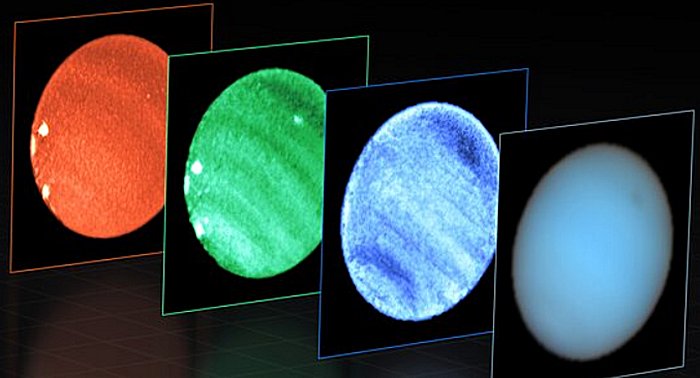
Eddie Gonzales Jr. – MessageToEagle.com – Using ESO’s Very Large Telescope (VLT), astronomers have observed a large dark spot in Neptune’s atmosphere, with an unexpectedly smaller bright spot adjacent to it. This image shows Neptune observed with the MUSE instrument at ESO’s Very Large Telescope (VLT). At each pixel within Neptune, MUSE splits the incoming

Short-Lived And Elusive Neptune Dark Spot Observed From Earth For The First Time Read More »

First Observational Evidence of Gamma-Ray Emission In Young Sun-Like Stars

First Observational Evidence of Gamma-Ray Emission In Young Sun-Like Stars

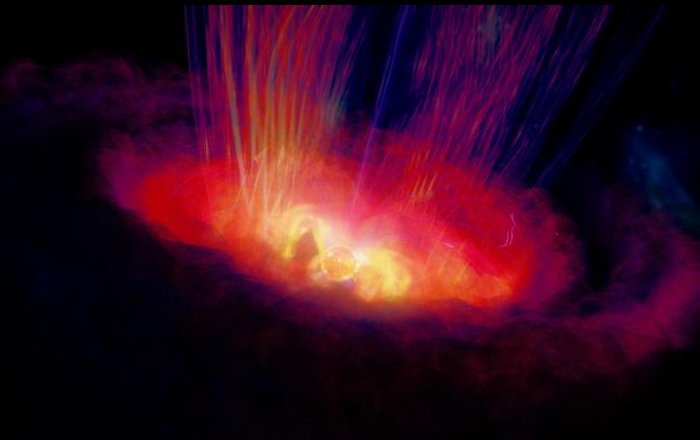
Eddie Gonzales Jr. – MessageToEagle.com – A team of scientists from Argentina and Spain have reported the first observational evidence that a type of young low-mass star, known as T Tauri stars, are capable of emitting gamma radiation. Artist’s impression of a T Tauri star: system formed by a central star and a circumstellar disk.

First Observational Evidence of Gamma-Ray Emission In Young Sun-Like Stars Read More »

New Type Of Star Sheds Light On Mysterious Origin Of Magnetars

New Type Of Star Sheds Light On Mysterious Origin Of Magnetars

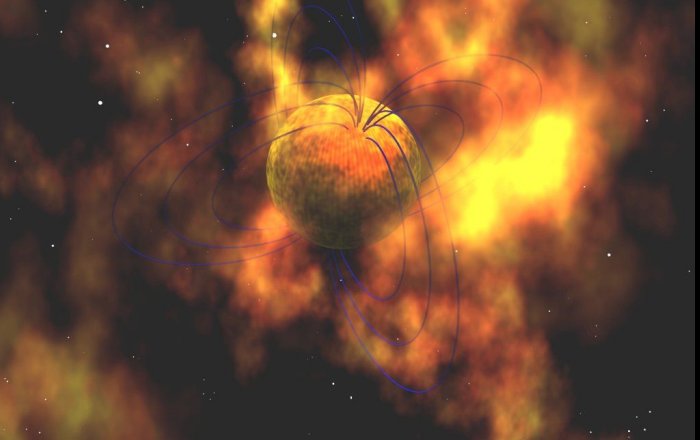
Eddie Gonzales Jr. – MessageToEagle.com – Magnetars are the strongest magnets in the Universe. These super-dense dead stars with ultra-strong magnetic fields can be found all over our galaxy but astronomers don’t know exactly how they form. Author: Dr. Robert Mallozzi/University of Alabama in Huntsville working at NASA/Marshall Space Flight Center. Public Domain Now, using

New Type Of Star Sheds Light On Mysterious Origin Of Magnetars Read More »

Maisie’s Galaxy is Among Earliest Ever Observed - Astronomers Confirm

Maisie’s Galaxy is Among Earliest Ever Observed – Astronomers Confirm

Eddie Gonzales Jr. – MessageToEagle.com – Detected with the James Webb Space Telescope, Maisie’s galaxy was observed 390 million years after the Big Bang. Spectroscopic observations reveal that Maisie’s galaxy, named after Steven Finkelstein’s daughter, was detected 390 million years after the Big Bang. That makes it one of the four earliest confirmed galaxies ever

Maisie’s Galaxy is Among Earliest Ever Observed – Astronomers Confirm Read More »

After 15 Years, Pulsar Timing Yields Evidence Of Cosmic Gravitational Wave Background

After 15 Years, Pulsar Timing Yields Evidence Of Cosmic Gravitational Wave Background

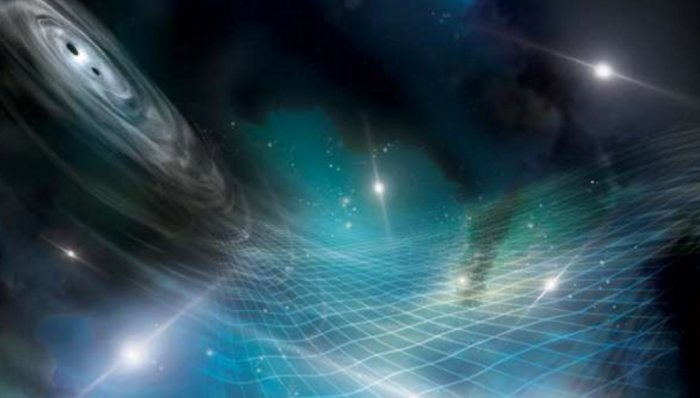
Eddie Gonzales Jr. – MessageToEagle.com – The universe is humming with gravitational radiation — a very low-frequency rumble that rhythmically stretches and compresses spacetime and the matter embedded in it. Artist’s interpretation of an array of pulsarsbeing affected by gravitational ripples producedby a supermassive black hole binary in a distantgalaxy. Credit: Aurore Simonnet for the

After 15 Years, Pulsar Timing Yields Evidence Of Cosmic Gravitational Wave Background Read More »