Astronomy

Astronomy

Our Universe is amazing and full of cosmic mysteries and curious anomalies. Since the dawn of history, humans have gazed at the night sky and wondered what is really out there. Where can we find extraterrestrials? What would alien worlds look like? There is still so much we don’t know about the Universe.

In this section, we take you on a journey to distant worlds and explore the secrets of our universe. You’ll find here the latest astronomy news, remarkable facts about the cosmos and space mysteries scientists are still trying to solve.

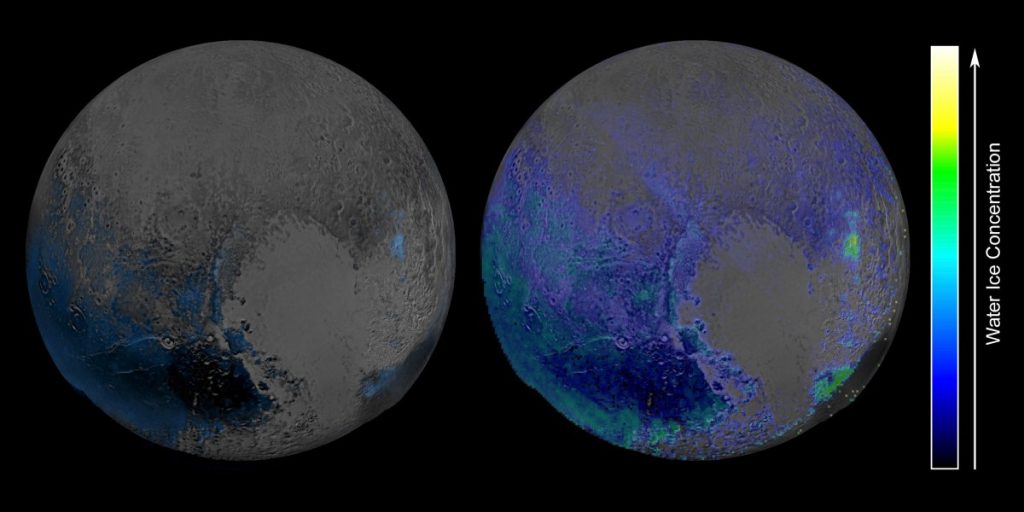
These maps of water ice on Pluto's surface were created using data captured by NASA's New Horizons spacecraft during its flyby of the dwarf planet on July 14, 2015. The map at left is an early effort; the one at right used modeling techniques to achieve greater sensitivity. Credit: NASA/JHUIAPL/SwRI

Pluto’s Surface Has A Surprising Amount Of Water Ice (Photo)

MessageToEagle.com – Water ice is surprisingly abundant on Pluto’s surface, a new map of the dwarf planet reveals. Scientists created the map using data collected by NASA’s New Horizons spacecraft during its epic flyby of Pluto last July. The new map is more sensitive than an earlier version also produced using flyby observations, and thus shows

Pluto’s Surface Has A Surprising Amount Of Water Ice (Photo) Read More »
It was assumed that Babylonian astronomers used only arithmetical methods. "The new interpretation reveals that Babylonian astronomers also used geometrical methods"

Babylonian Astronomers Used Geometry To Track Jupiter – 1,400 Years Before Europeans

MessageToEagle.com – An analysis of three published and two unpublished cuneiform tablets from the British Museum has revealed that Babylonian astronomers used geometry to calculate the motions of Jupiter – 1,400 years before Europeans. The discovery was made by Prof. Mathieu Ossendrijver, historian of science of the Humboldt-Universität in Berlin, who translated and interpreted five clay tablets

Babylonian Astronomers Used Geometry To Track Jupiter – 1,400 Years Before Europeans Read More »

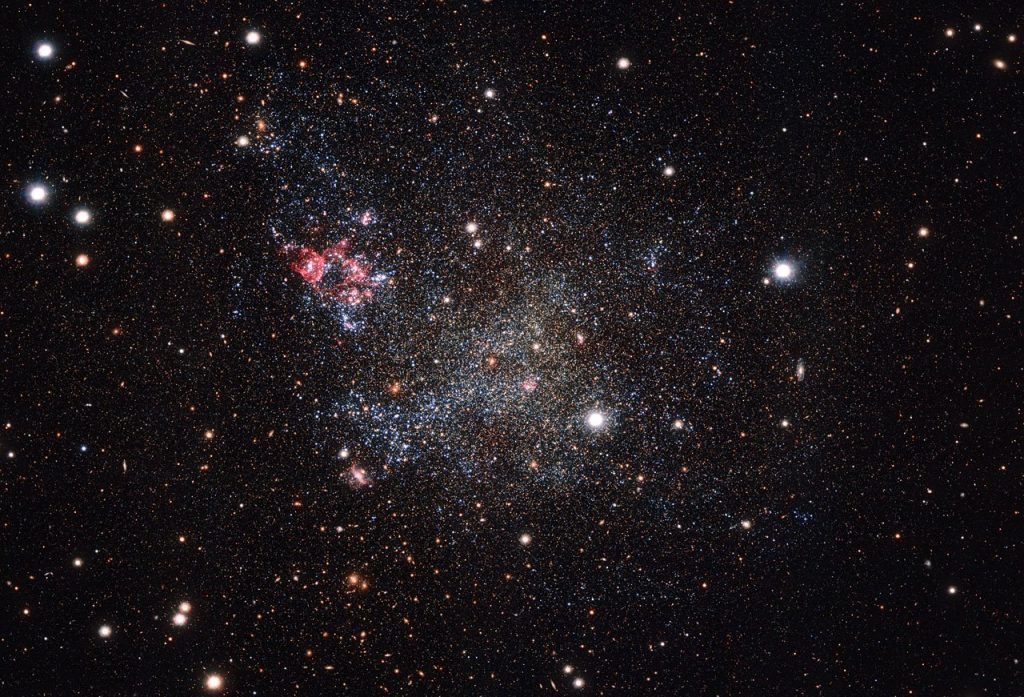
This image, captured with the OmegaCAM camera on ESO’s VLT Survey Telescope in Chile, shows an unusually clean small galaxy. IC 1613 contains very little cosmic dust, allowing astronomers to explore its contents with great clarity. Credit: ESO

Unusual Photo Of Small Galaxy IC 1613 As Seen By ESO’s VLT Survey Telescope In Chile

MessageToEagle.com – There is a beautiful small galaxy C 1613 located in the constellation of Cetus (The Sea Monster). It is now confirmed that IC 1613 – well-studied due to its proximity – is indeed a member of the Local Group, a collection of more than 50 galaxies that includes our home galaxy, the Milky Way. IC 1613, located just

Unusual Photo Of Small Galaxy IC 1613 As Seen By ESO’s VLT Survey Telescope In Chile Read More »

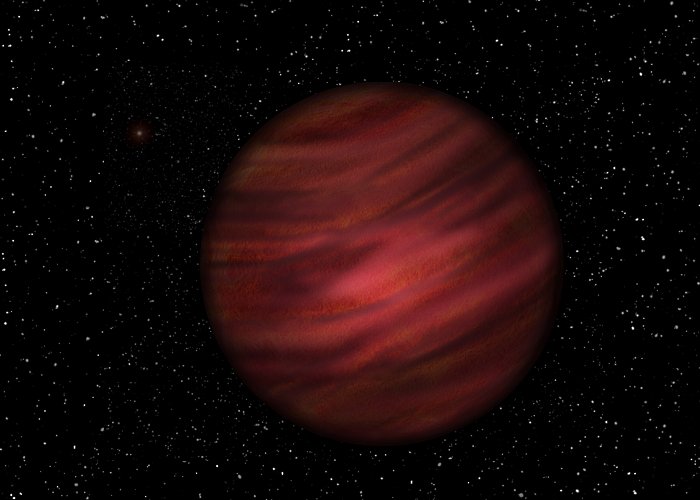
Lonely Planet Orbits Its Star At The Distance Of One Trillion Kilometers

MesageToEagle.com – An international team of astronomers from UK, USA and Australia have found a planet designated as 2MASS J2126, which was thought to be a free floating or lonely planet. However, the planet is not quite alone because it orbits its star but it does at the huge distance of approximately one trillion kilometers, or

Lonely Planet Orbits Its Star At The Distance Of One Trillion Kilometers Read More »

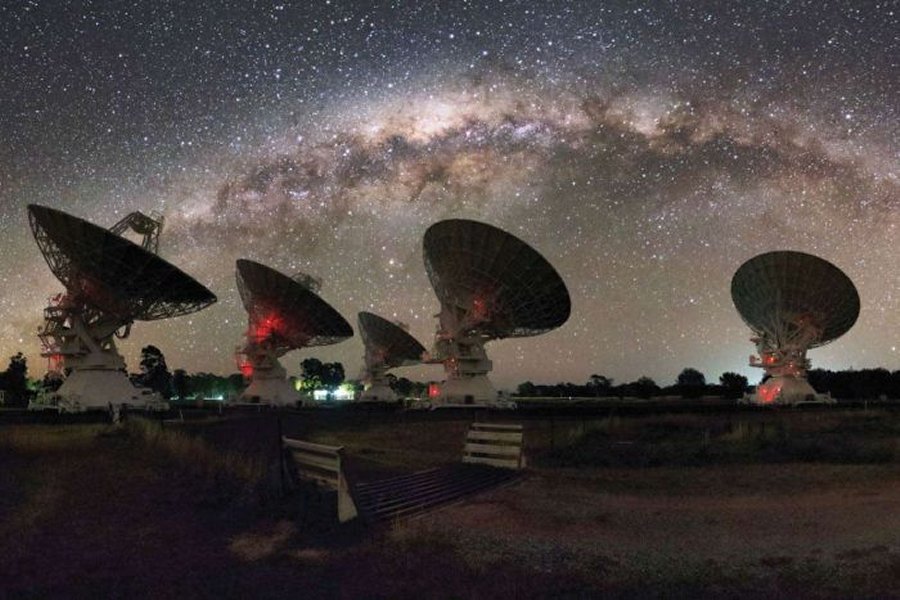
CSIRO's Compact Array in Australia is shown under the night lights of the Milky Way. Credit: Alex Cherney

Noodles-Like Invisible Structures Lurking In The Milky Way

MessageToEagle.com – Invisible structures shaped like noodles, lasagne sheets or hazelnuts could be floating around in our Galaxy radically challenging our understanding of gas conditions in the Milky Way. CSIRO astronomer and first author of a paper released in Science Dr Keith Bannister said the structures appear to be ‘lumps’ in the thin gas that lies

Noodles-Like Invisible Structures Lurking In The Milky Way Read More »

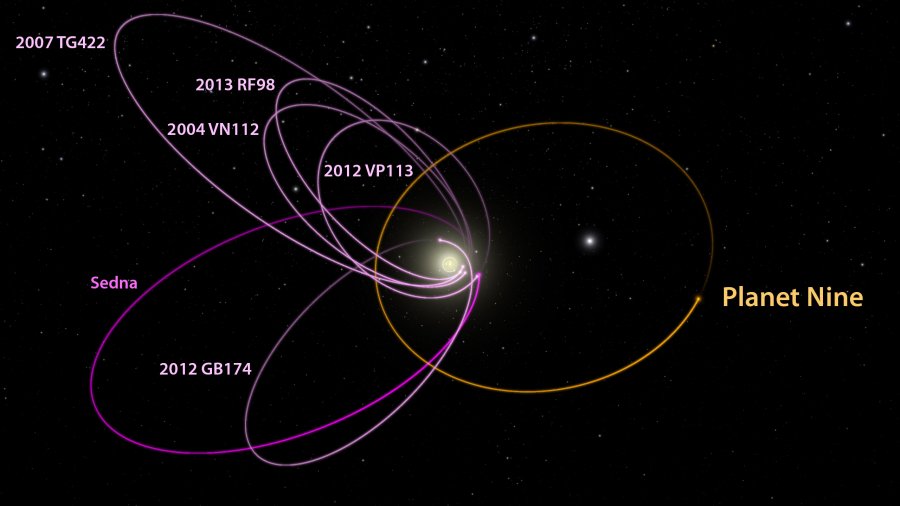
A planet with 10 times the mass of Earth may be orbiting the sun beyond Neptune. This image shows the theorized orbit of the giant planet and six other solar system objects beyond Neptune. Credit: Caltech/R. Hurt (IPAC)

‘Planet Nine’ May Exist: New Evidence for Another World in Our Solar System

MessageToEagle.com – The mythical “Planet X” may actually be real, and scientists are calling it “Planet Nine.” Astronomers have found evidence for a planet 10 times more massive than Earth in the far outer solar system, orbiting about 20 times farther from the sun than distant Neptune does. “This would be a real ninth planet,” one

‘Planet Nine’ May Exist: New Evidence for Another World in Our Solar System Read More »

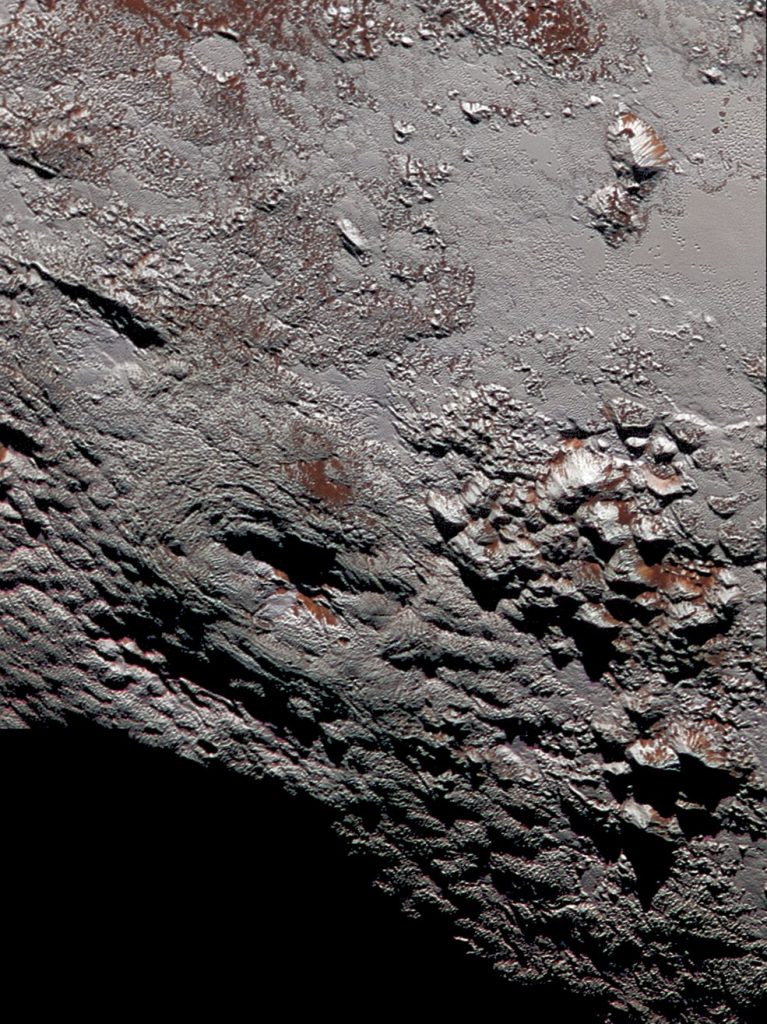
This composite image of a possible ice volcano on Pluto includes pictures taken by the New Horizons spacecraft’s Long Range Reconnaissance Imager (LORRI) on July 14, 2015, from a range of about 30,000 miles (48,000 kilometers), showing features as small as 1,500 feet (450 meters) across. Sprinkled across the LORRI mosaic is enhanced color data from the Ralph/Multispectral Visible Imaging Camera (MVIC), from a range of 21,000 miles (34,000 kilometers) and at a resolution of about 2,100 feet (650 meters) per pixel. The entire scene is 140 miles (230 kilometers) across. Image credit: NASA/JHUAPL/SwRI

NASA New Horizons’ New Image Of 150km-Wide Potential ‘Cryovolcano’ On Pluto

MessageToEagle.com – Scientists with NASA’s New Horizons mission have assembled this highest-resolution color view of one of two potential cryovolcanoes spotted on the surface of Pluto by the New Horizons spacecraft in July 2015. This feature, known as Wright Mons, was informally named by the New Horizons team in honor of the Wright brothers. At about

NASA New Horizons’ New Image Of 150km-Wide Potential ‘Cryovolcano’ On Pluto Read More »

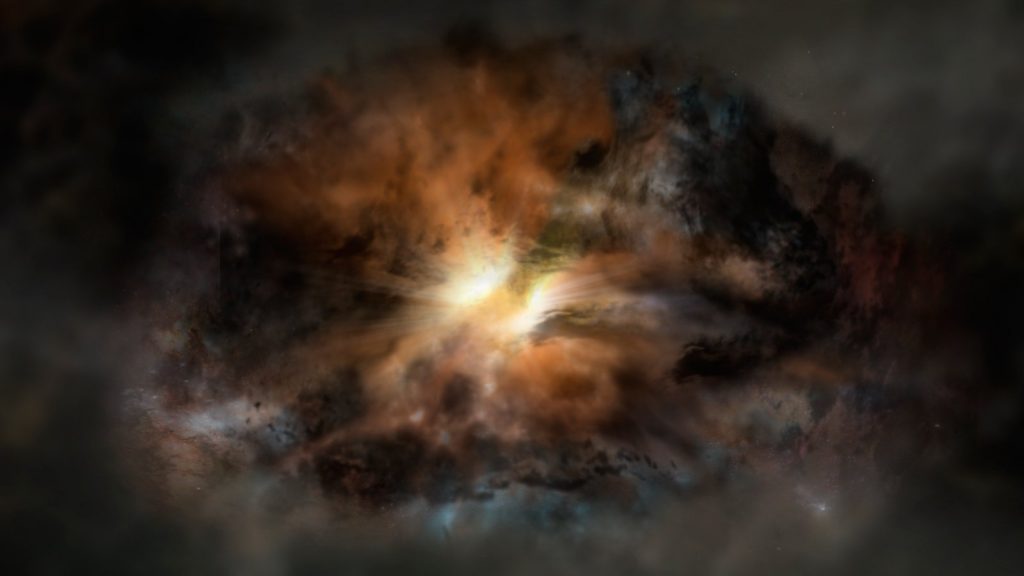
This artist's rendering shows a galaxy called W2246-0526, the most luminous galaxy known. New research suggests there is turbulent gas across its entirety, the first example of its kind. Image credit: NRAO/AUI/NSF; Dana Berry / SkyWorks; ALMA (ESO/NAOJ/NRAO)

Turbulent And ‘Most Luminous Galaxy’ Is Ripping Itself Apart

MessageToEagle.com – Astronomers have recently discovered a far-off galaxy W2246-0526, 12.4 billion light-years from Earth, which is the most luminous galaxy known, according to research published in 2015, based on data from NASA’s Wide-field Infrared Survey Explorer (WISE). A voracious black hole is devouring galactic grub and its feeding frenzy produces so much energy, it stirs up

Turbulent And ‘Most Luminous Galaxy’ Is Ripping Itself Apart Read More »