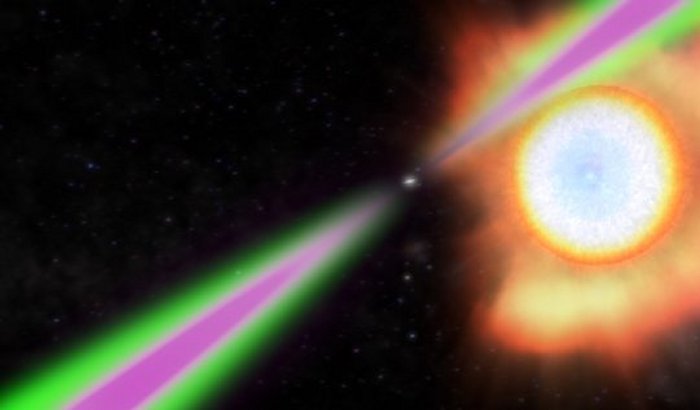
A black widow pulsar and its small stellar companion, viewed within their orbital plane. Powerful radiation and the pulsar's “wind” – an outflow of high-energy particles — strongly heat the facing side of the star to temperatures twice as hot as the sun's surface. The pulsar is gradually evaporating its partner, which fills the system with ionized gas and prevents astronomers from detecting the pulsar's radio beam most of the time. Credit: NASA's Goddard Space Flight Center/Cruz deWilde
Astronomy

Fastest Spinning Radio Pulsar J0952-0607 Has A Companion And Emits Pulsed Gamma Rays

Eddie Gonzales Jr. – MessageToEagle.com – The radio pulsar J0952-0607 rotates 707 times in a single second and is, therefore, the […]