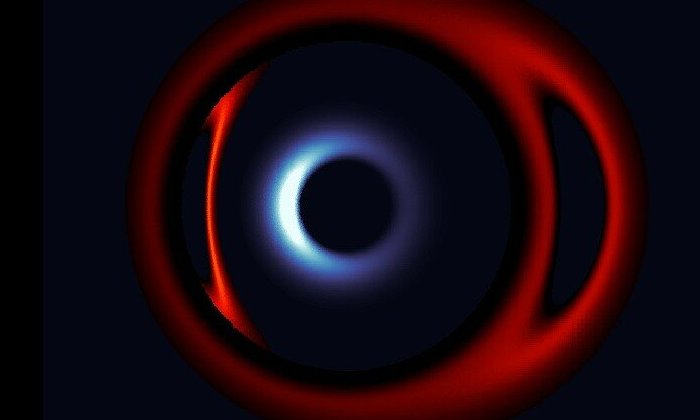
In this simulation of a supermassive black hole merger, the blue-shifted black hole closest to the viewer amplifies the red-shifted black hole in the back through gravitational lensing. The researchers discovered a distinct dip in brightness when the closest black hole passed in front of the shadow of its counterpart, an observation that could be used to measure the size of both black holes and test alternative theories of gravity. Credit: Jordy Davelaar
Astronomy

In A Pair Of Merging Supermassive Black Holes, A New Method For Measuring The Void

Eddie Gonzales Jr. – MessageToEagle.com – Three years ago, the first-ever image of a black hole stunned the world. A […]