Astronomy

Astronomy

Our Universe is amazing and full of cosmic mysteries and curious anomalies. Since the dawn of history, humans have gazed at the night sky and wondered what is really out there. Where can we find extraterrestrials? What would alien worlds look like? There is still so much we don’t know about the Universe.

In this section, we take you on a journey to distant worlds and explore the secrets of our universe. You’ll find here the latest astronomy news, remarkable facts about the cosmos and space mysteries scientists are still trying to solve.

Milky Way's Black Hole Was 'Birth Cry' Of Radio Astronomy

Milky Way’s Black Hole Was ‘Birth Cry’ Of Radio Astronomy

Eddie Gonzales Jr. – MessageToEagle.com – The first image of the supermassive black hole at the center of our Milky Way galaxy brings radio astronomy back to its celestial birthplace. The Event Horizon Telescope (EHT), a worldwide collection of millimeter-wave radio telescopes, made the new, landmark image of the same region from which came the

Milky Way’s Black Hole Was ‘Birth Cry’ Of Radio Astronomy Read More »

Universe

Quadruple Stars That May Spark Supernova Explosions – Spotted

Eddie Gonzales Jr. – MessageToEagle.com – A quadruple star system discovered in 2017 and recently observed at the University of Canterbury Mt. John Observatory could represent a new channel by which thermonuclear supernova explosions can occur in the universe, according to a new study. Image credit: Pixabay The rare double-binary star system HD74438 was discovered in

Quadruple Stars That May Spark Supernova Explosions – Spotted Read More »

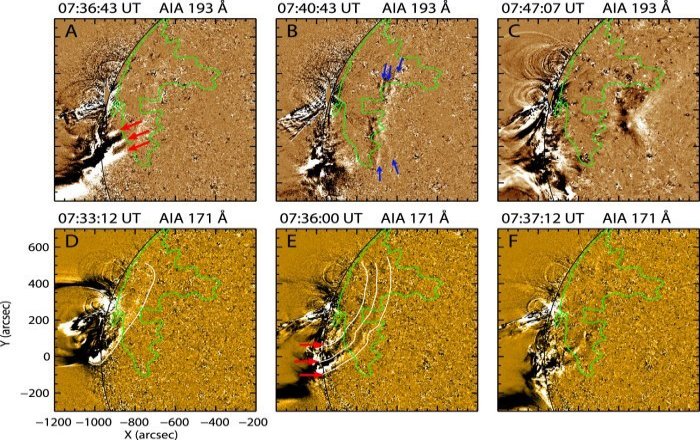
The AIA 193 Å (a)–(c) and 171 Å (d)–(f) running-difference images show the evolution of the wave train. The white curves in panels (d) and (e) tracing the wave front are added to visualize the wave evolution, which is drawn by connecting a sequence of measurement points. The red and blue arrows point to the wave fronts at the different evolutionary stages. The closed region marks the lunate CH boundary. Credit: The Astrophysical Journal Letters (2022). DOI: 10.3847/2041-8213/ac651e

Solid Evidence Of Coronal Waves Excited By Flares – Found

Eddie Gonzales Jr. – MessageToEagle.com – Researchers led by Dr. Zhou Xinping from Yunnan Observatories of the Chinese Academy of Sciences and their collaborators have found solid evidence of coronal waves excited by flares. Their study – published in The Astrophysical Journal Letters –  implies that the broad extreme-ultraviolet (EUV) wave train, including multiple wavefronts,

Solid Evidence Of Coronal Waves Excited By Flares – Found Read More »

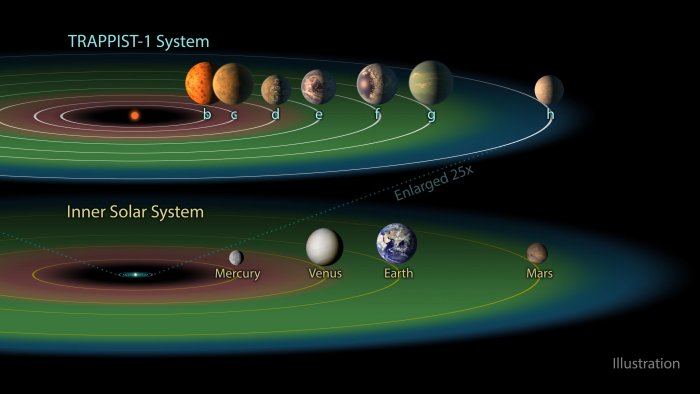
An SwRI-led study suggests that host-star age and radionuclide abundance will help determine both an exoplanet's history and its current likelihood of being temperate today. For example, the red dwarf star TRAPPIST-1 is home to the largest group of roughly Earth-sized planets ever found in a single stellar system with seven rocky siblings including four in the habitable zone. But at around 8 billion years old, these worlds are roughly 2 billion years older than the most optimistic degassing lifetime predicted by this study and unlikely to support a temperate climate today. Credit: NASA/JPL-Caltech

Younger Exoplanets Are Better Candidates When Looking For Other Earths

Eddie Gonzales Jr. – MessageToEagle.com – As the scientific community searches for worlds orbiting nearby stars that could potentially harbor life, new Southwest Research Institute-led research suggests that younger rocky exoplanets are more likely to support temperate, Earth-like climates. In the past, scientists have focused on planets situated within a star’s habitable zone, where it

Younger Exoplanets Are Better Candidates When Looking For Other Earths Read More »

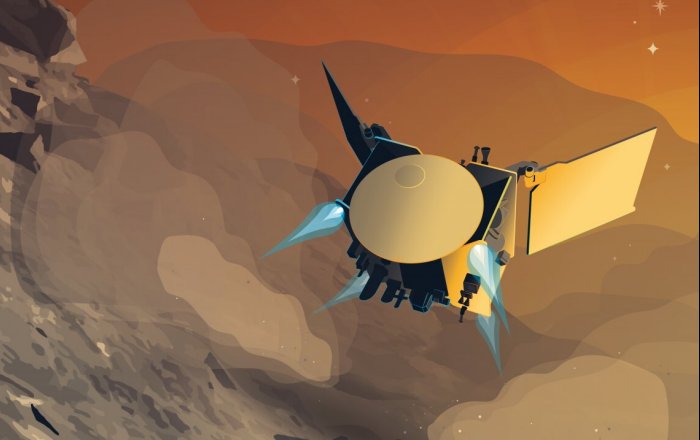
This is an artists illustration of the OSIRIS-REx spacecraft firing thrusters near the surface of the asteroid Apophis. Credit: Heather Roper

NASA Gives Green Light For OSIRIS-REx Spacecraft To Visit Another Asteroid

Eddie Gonzales Jr. – MessageToEagle.com – NASA’s OSIRIS-REx spacecraft will swing by Earth to deliver a sample from asteroid Bennu on Sept. 24, 2023. But it won’t clock out after that. This is an artists illustration of the OSIRIS-REx spacecraft firing thrusters near the surface of the asteroid Apophis. Credit: Heather Roper NASA has extended

NASA Gives Green Light For OSIRIS-REx Spacecraft To Visit Another Asteroid Read More »

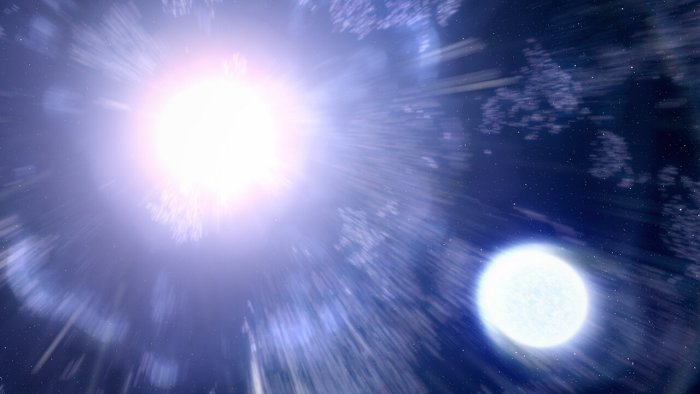
This artist's illustration shows supernova 2013ge, with its companion star at lower right. The companion star is impacted by the blast wave from the supernova, but not destroyed. Over time astronomers observed the ultraviolet (UV) light of the supernova fading, revealing a nearby second source of UV light that maintained brightness. The theory is that the two massive stars evolved together as a binary pair, and that the current survivor siphoned off its partner's outer hydrogen gas shell before it exploded. Eventually, the companion star will also go supernova. Credit: NASA, ESA, Leah Hustak (STScI)

Surviving Companion Star In Aftermath Of Supernova – Revealed By Hubble

Eddie Gonzales Jr. – MessageToEagle.com – NASA’s Hubble Space Telescope has uncovered a witness at the scene of a star’s explosive death: a companion star previously hidden in the glare of its partner’s supernova. The discovery is a first for a particular type of supernova—one in which the star was stripped of its entire outer

Surviving Companion Star In Aftermath Of Supernova – Revealed By Hubble Read More »