Astronomy

Astronomy

Our Universe is amazing and full of cosmic mysteries and curious anomalies. Since the dawn of history, humans have gazed at the night sky and wondered what is really out there. Where can we find extraterrestrials? What would alien worlds look like? There is still so much we don’t know about the Universe.

In this section, we take you on a journey to distant worlds and explore the secrets of our universe. You’ll find here the latest astronomy news, remarkable facts about the cosmos and space mysteries scientists are still trying to solve.

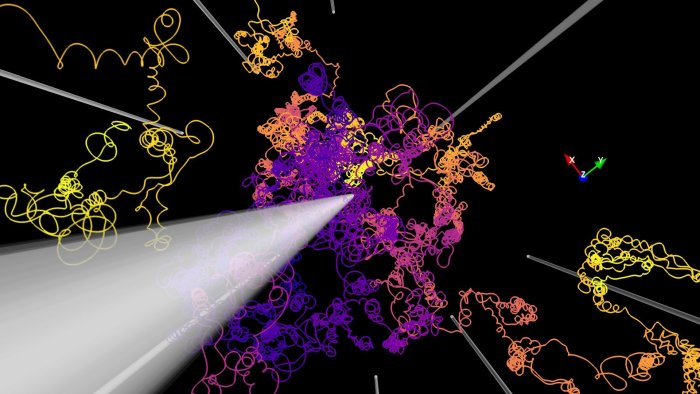
The coloured lines show how cosmic rays are deflected in magnetic fields. The white straight lines represent a large-scale magnetic field. In addition, small-scale magnetic fields not shown here act on the paths of the particles (coloured lines). Credit: RUB, Dr. Lukas Merten

Search For The Origin Of Cosmic Rays And New Computer Simulation

Eddie Gonzales Jr. – MessageToEagle.com – An international research team has developed a computer program that can simulate the transport of cosmic rays through space. The researchers hope it will help them solve the mystery of the sources of cosmic rays. So far, we do not know which celestial objects emit the high-energy radiation that pelts

Search For The Origin Of Cosmic Rays And New Computer Simulation Read More »

Could More Of Earth's Surface Host Life? Jupiter's Orbit Shape Plays Key, Overlooked Role On Earth

Could More Of Earth’s Surface Host Life? Jupiter’s Orbit Shape Plays Key, Overlooked Role On Earth

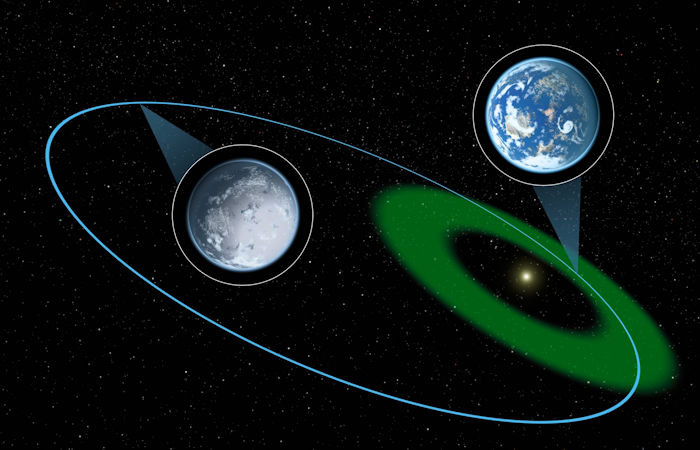
Eddie Gonzales Jr. – MessageToEagle.com – Of all known planets, Earth is as friendly to life as any planet could possibly be—or is it? If Jupiter’s orbit changes, a new study shows Earth could be more hospitable than it is today. When a planet has a perfectly circular orbit around its star, the distance between the star

Could More Of Earth’s Surface Host Life? Jupiter’s Orbit Shape Plays Key, Overlooked Role On Earth Read More »

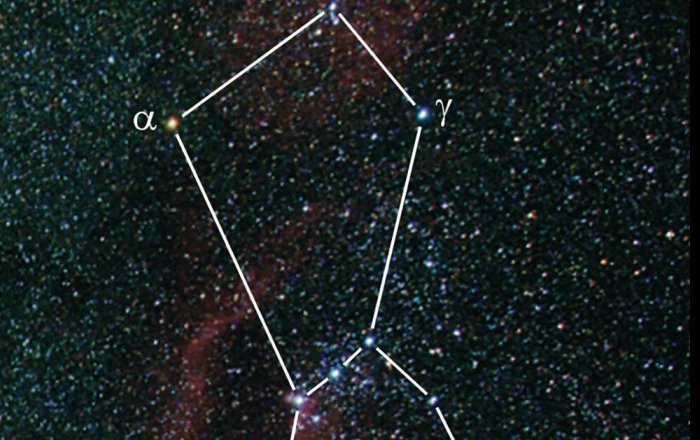
The constellation Orion, Betelgeuse is marked with Alpha. Credit: Markus Mugrauer

Red Giant Betelgeuse Was Yellow Some 2,000 Years Ago

Eddie Gonzales Jr. – MessageToEagle.com – An interdisciplinary team centered around a Jena astrophysicist utilized observations from antiquity to prove that Betelgeuse—the bright red giant star in the upper left of the constellation Orion—was yellow-orange some 2,000 years ago. The constellation Orion, Betelgeuse is marked with Alpha. Credit: Markus Mugrauer As nuclear fusion in the

Red Giant Betelgeuse Was Yellow Some 2,000 Years Ago Read More »

Why Do Galaxies Stop Making Stars? A Huge Collision In Space Provides New Clues

Why Do Galaxies Stop Making Stars? A Huge Collision In Space Provides New Clues

Eddie Gonzales Jr. – MessageToEagle.com – Six billion years ago, two galaxies were colliding, their combined forces hurling a stream of gas hundreds of thousands of light years away. Reported this week by a team including Pitt astronomers, that unusual feature provides a new possible explanation for why galaxies stop forming stars. Image credit: Pixabay

Why Do Galaxies Stop Making Stars? A Huge Collision In Space Provides New Clues Read More »

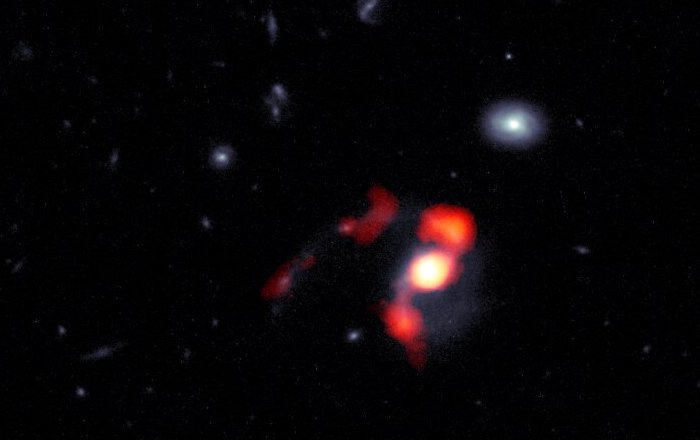
SDSS J1448+1010 is a newly-dormant massive galaxy that was born when the Universe was at roughly half of its current age, and is nearing the completion of a merger with another galaxy. During the course of this merger, the force of gravity flung what amounts to nearly half of the system’s star-forming gas away from the galaxy, leaving it unable to form new stars. This composite image combines blue/white data from the Hubble Space Telescope (HST) and red/orange data from the Atacama Large Millimeter/submillimeter Array (ALMA) to show the post-merger distribution of gas and stars from the now-dormant galaxy into streams of material known as tidal tails. Credit: ALMA (ESO/NAOJ/NRAO), J. Spilker et al (Texas A&M), S. Dagnello (NRAO/AUI/NSF)

ALMA Witnesses Deadly Star-Slinging Tug-Of-War Between Merging Galaxies

Eddie Gonzales Jr. – MessageToEagle.com – While observing a newly-dormant galaxy using the Atacama Large Millimeter/submillimeter Array (ALMA) and the Hubble Space Telescope (HST), scientists discovered that it had stopped forming stars not because it had used up all of its gas but because most of its star-forming fuel had been thrown out of the

ALMA Witnesses Deadly Star-Slinging Tug-Of-War Between Merging Galaxies Read More »

'Diamond Rain' On Giant Icy Planets - More Common Than Previously Thought?

‘Diamond Rain’ On Giant Icy Planets – More Common Than Previously Thought?

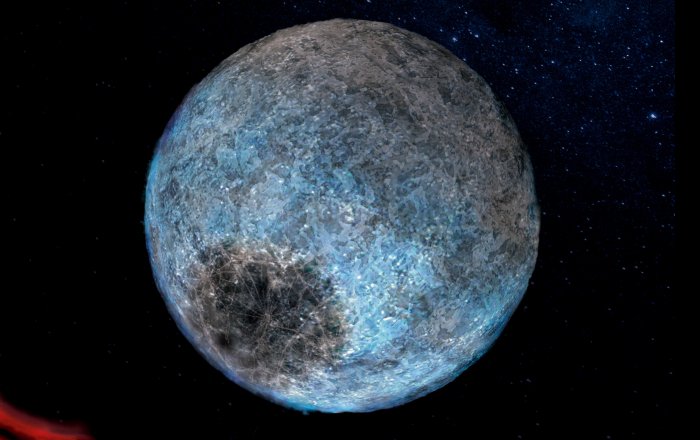
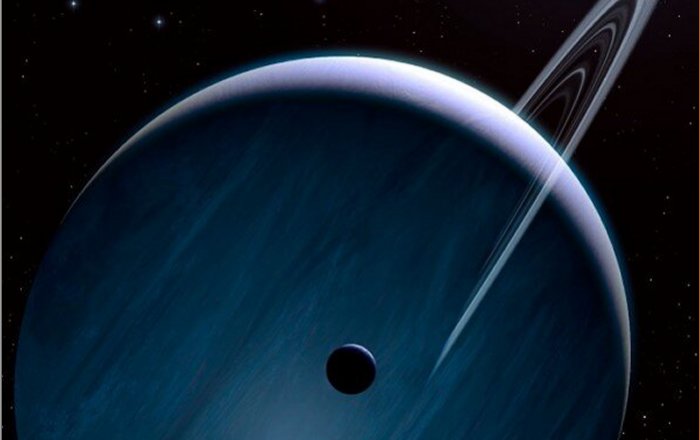
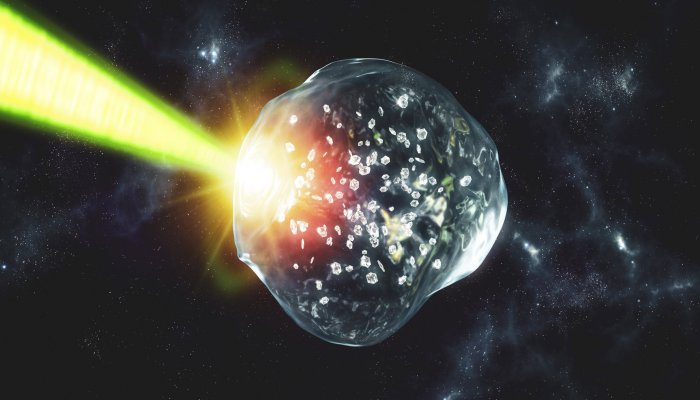
Eddie Gonzales Jr. – MessageToEagle.com – A new study has found that “diamond rain,” a long-hypothesized exotic type of precipitation on ice giant planets, could be more common than previously thought. In an earlier experiment, researchers mimicked the extreme temperatures and pressures found deep inside ice giants Neptune and Uranus and, for the first time,

‘Diamond Rain’ On Giant Icy Planets – More Common Than Previously Thought? Read More »

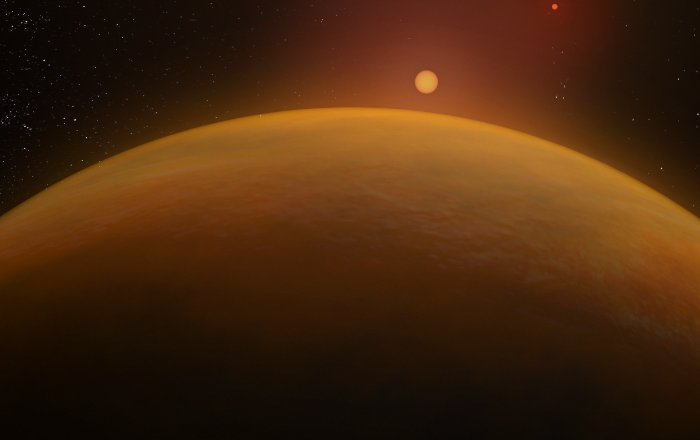
From above a planet about twice the size of Jupiter, this artist's conception shows the star that planet is orbiting and that star's binary companion in the distance. Credit: Sophia Dagnello, NRAO/AUI/NSF.

First Full 3-D View Of Binary Star-Planet System Produced By VLBA

Eddie Gonzales Jr. – MessageToEagle.com – By precisely tracing a small, almost imperceptible, wobble in a nearby star’s motion through space, astronomers have discovered a Jupiter-like planet orbiting that star, which is one of a binary pair. From above a planet about twice the size of Jupiter, this artist’s conception shows the star that planet

First Full 3-D View Of Binary Star-Planet System Produced By VLBA Read More »