Astronomy

Astronomy

Our Universe is amazing and full of cosmic mysteries and curious anomalies. Since the dawn of history, humans have gazed at the night sky and wondered what is really out there. Where can we find extraterrestrials? What would alien worlds look like? There is still so much we don’t know about the Universe.

In this section, we take you on a journey to distant worlds and explore the secrets of our universe. You’ll find here the latest astronomy news, remarkable facts about the cosmos and space mysteries scientists are still trying to solve.

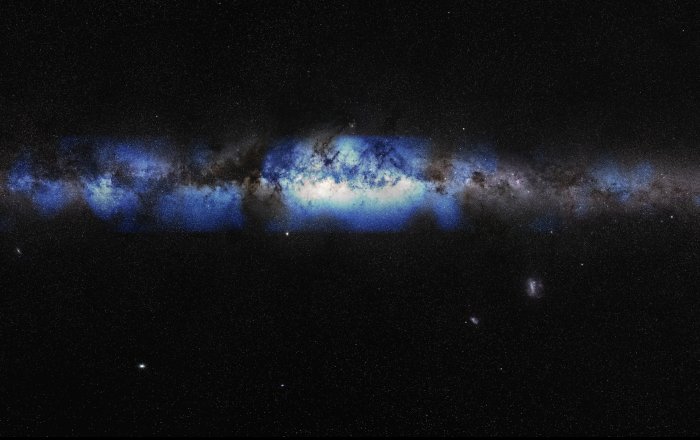
First 'Ghost Particle' Image Of Milky Way Galaxy Captured By Scientists: Neutrinos Detected By IceCube

First ‘Ghost Particle’ Image Of Milky Way Galaxy Captured By Scientists: Neutrinos Detected By IceCube

Eddie Gonzales Jr. – MessageToEagle.com – Our Milky Way galaxy is an awe-inspiring feature of the night sky, viewable with the naked eye as a horizon-to-horizon hazy band of stars. Now, for the first time, the IceCube Neutrino Observatory has produced an image of the Milky Way using neutrinos—tiny, ghostlike astronomical messengers. An artist’s composition

First ‘Ghost Particle’ Image Of Milky Way Galaxy Captured By Scientists: Neutrinos Detected By IceCube Read More »

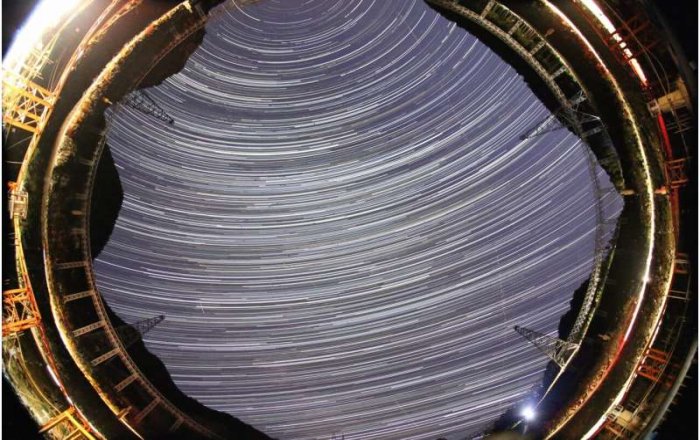
Key Evidence For Existence Of Nanohertz Gravitational Waves - Found

Key Evidence For Existence Of Nanohertz Gravitational Waves – Found

Eddie Gonzales Jr. – MessageToEagle.com – A group of Chinese scientists has recently found key evidence for the existence of nanohertz gravitational waves, marking a new era in nanohertz gravitational wave research. The research was based on pulsar timing observations carried out with the Five-hundred-meter Aperture Spherical radio Telescope (FAST FAST helps find key evidence

Key Evidence For Existence Of Nanohertz Gravitational Waves – Found Read More »

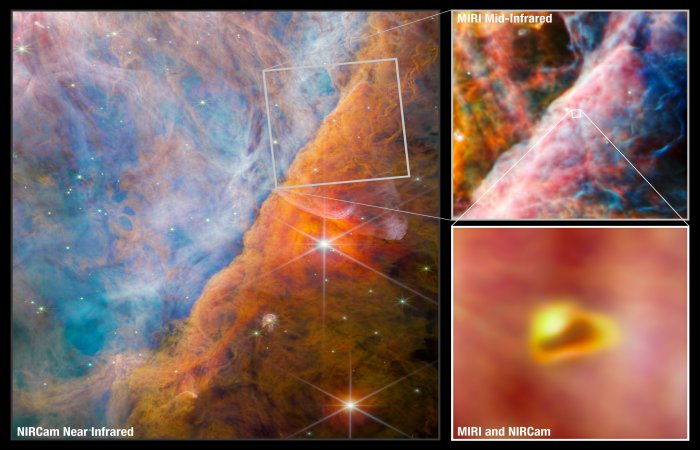
First Detection Of Crucial Carbon Molecule Made By Webb

First Detection Of Crucial Carbon Molecule Made By Webb

Eddie Gonzales Jr. – MessageToEagle.com – Known as methyl cation (pronounced cat-eye-on) (CH3+), the molecule is important because it aids the formation of more complex carbon-based molecules. Methyl cation was detected in a young star system, with a protoplanetary disk, known as d203-506, which is located about 1,350 light-years away in the Orion Nebula. These

First Detection Of Crucial Carbon Molecule Made By Webb Read More »

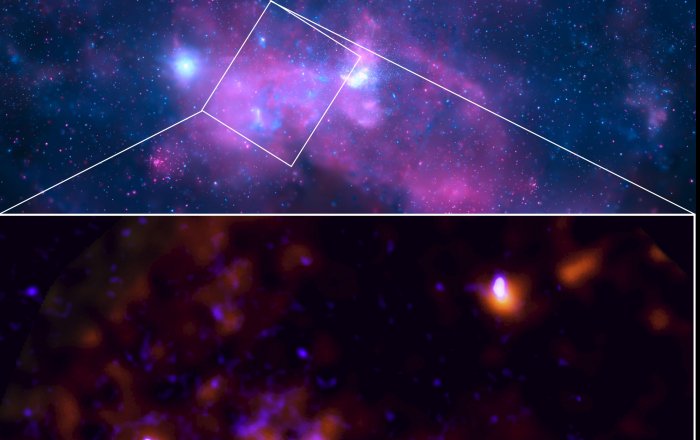
Detection Of An Echo Emitted By Sagittarius A* 200 Years Ago

Detection Of An Echo Emitted By Sagittarius A* 200 Years Ago

Eddie Gonzales Jr. – MessageToEagle.com – An international team of scientists has discovered that Sagittarius A* (Sgr A*), the supermassive black hole at the center of the Milky Way, emerged from a long period of dormancy some 200 years ago. New data from NASA’s Imaging X-ray Polarimetry Explorer (IXPE) has provided evidence that the supermassive

Detection Of An Echo Emitted By Sagittarius A* 200 Years Ago Read More »

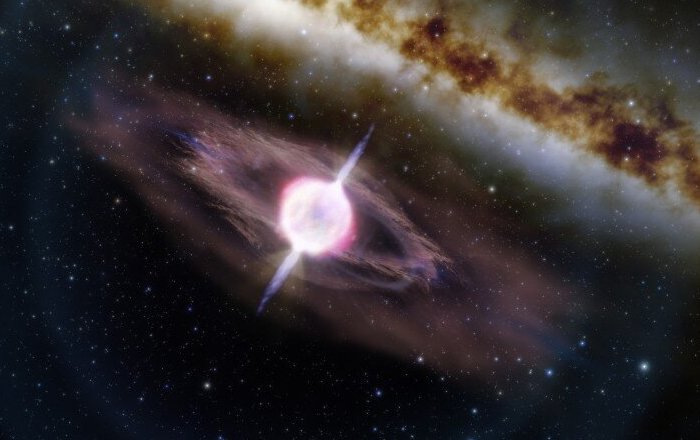
Artist illustration depicting a collapsing star that is producing two short gamma-ray jets. Credit: International Gemini Observatory/NOIRLab/NSF/AURA/J. da Silva Image processing: M. Zamani (NSF's NOIRLab)

‘Brightest Of All Time’ Gamma-Ray Burst And Its Ordinary Supernova

Eddie Gonzales Jr. – MessageToEagle.com – On 9 October 2022 a flash of high-intensity gamma rays was detected by NASA’s Swift satellite coming from a galaxy 1.9 billion light-years away. Dubbed the “BOAT”—the “brightest of all time”—GRB 221009A was so exceptionally powerful that it actually sent shockwaves through Earth’s ionosphere, the outer layer of our

‘Brightest Of All Time’ Gamma-Ray Burst And Its Ordinary Supernova Read More »

Unveiling Quantum Gravity: New Results From IceCube And Fermi Data

Unveiling Quantum Gravity: New Results From IceCube And Fermi Data

Eddie Gonzales Jr. – MessageToEagle.com – Researchers have reached a significant milestone in the field of quantum gravity research, finding preliminary statistical support for quantum gravity. Illustration of The Fermi Gamma-ray Space Telescope. Image credit: Illustration of The Fermi Gamma-ray Space Telescope. Credit: NASA/Fermi and Aurore Simonnet, Sonoma State University In a study published in

Unveiling Quantum Gravity: New Results From IceCube And Fermi Data Read More »

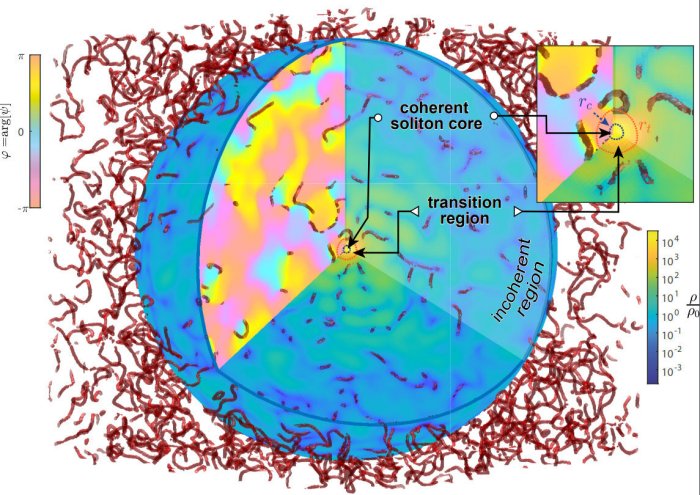
The center of a fuzzy dark matter halo, labelled "coherent soliton core" in the above picture, is physically indistinguishable from a coherent BEC like those created in typical cold atomic systems, but extending over thousands of light years. With the inclusion of a small transition region, the rest of the halo is incoherent due to a tangle of quantum vortices which criss-cross the halo's volume outside the vortex-free core. The vortex tangle is time dependent but the overall vorticity it creates remains constant in time. Credit: Dr. Gary Liu, Newcastle University

Research Sheds Light On New Model Of Cosmological Dark Matter

 Eddie Gonzales Jr. – MessageToEagle.com – Newcastle University researchers used insights gained from the study of ultracold atomic Bose Einstein condensates to analyze the behavior of fuzzy dark matter, a new model for cosmological dark matter that has recently drawn the attention of cosmologists. The center of a fuzzy dark matter halo, labelled “coherent soliton

Research Sheds Light On New Model Of Cosmological Dark Matter Read More »