MessageToEagle.com

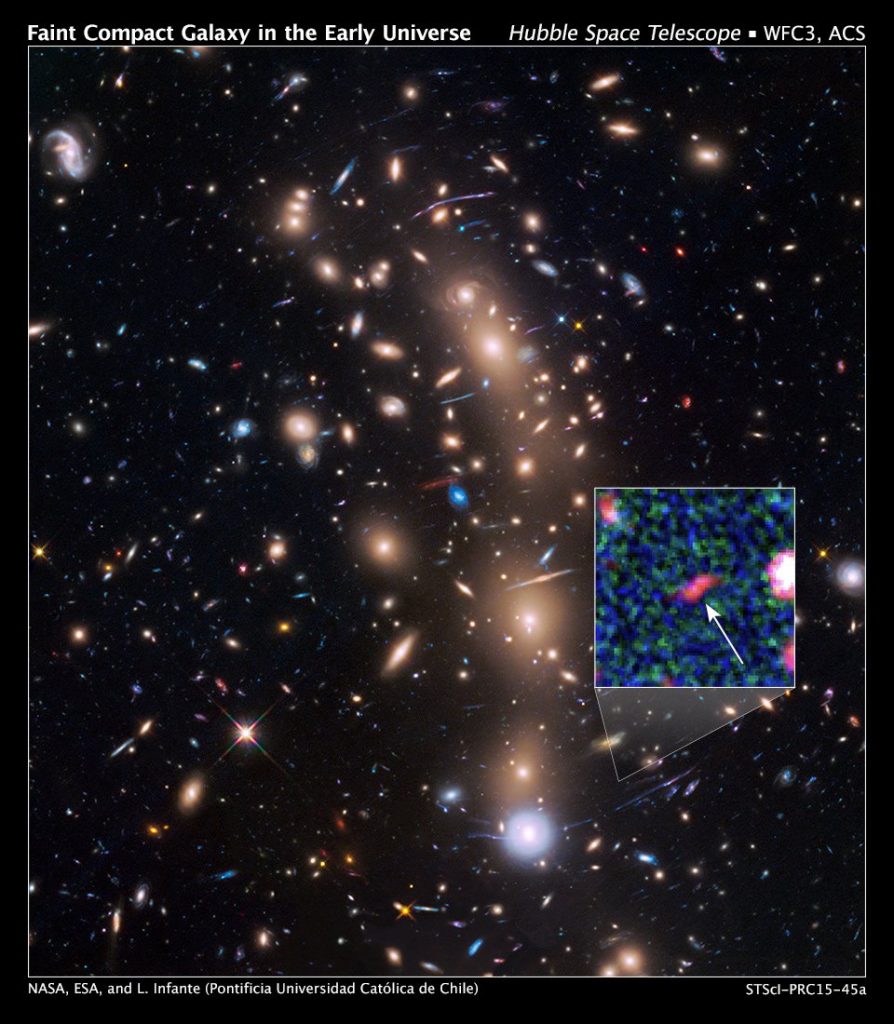
This is a Hubble Space Telescope view of a very massive cluster of galaxies, MACS J0416.1-2403, located roughly 4 billion light-years away and weighing as much as a million billion suns. The inset is an image of an extremely faint and distant galaxy that existed only 400 million years after the big bang. Hubble captured it because the gravitational lens makes the galaxy appear 20 times brighter than normal. Credit: Credits: NASA, ESA, and L. Infante (Pontificia Universidad Catolica de Chile)

NASA Space Telescopes See Magnified Image Of The Faintest Galaxy From The Early Universe

å+MessageToEagle.com – Using NASA’s Hubble and Spitzer space telescopes, astronomers have found the faintest object ever seen in the early universe. It existed about 400 million years after the big bang, 13.8 billion years ago. The team has nicknamed the object Tayna, which means “first-born” in Aymara, a language spoken in the Andes and Altiplano regions of

NASA Space Telescopes See Magnified Image Of The Faintest Galaxy From The Early Universe Read More »

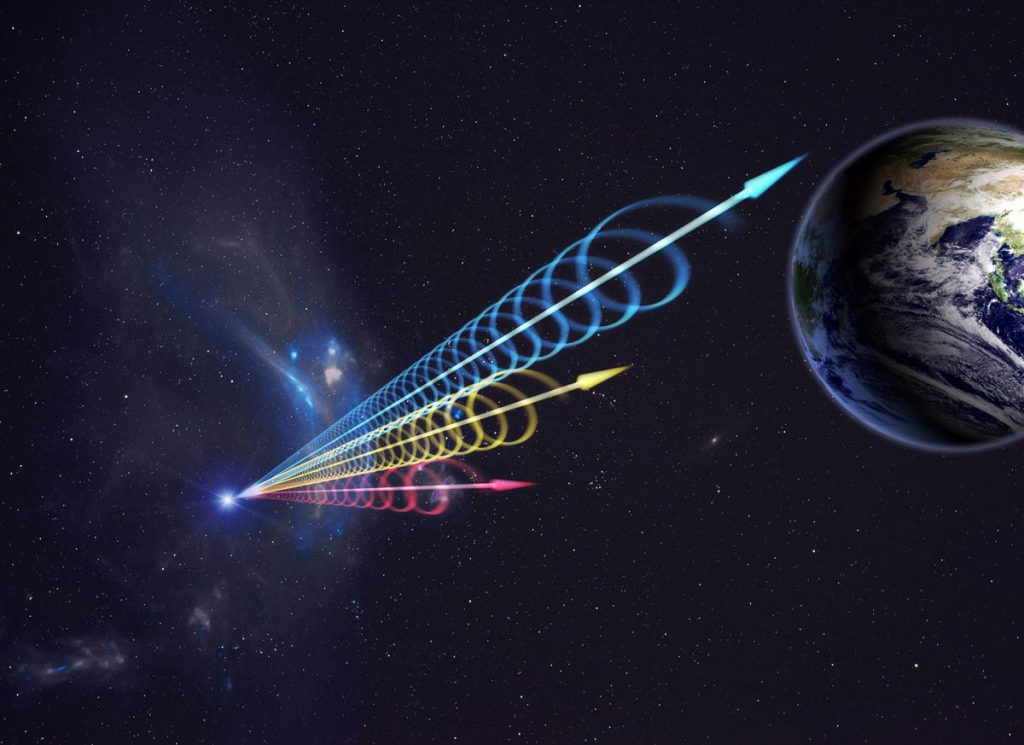
Artist impression of a Fast Radio Burst (FRB) reaching Earth. The colors represent the burst arriving at different radio wavelengths, with long wavelengths (red) arriving several seconds after short wavelengths (blue). This delay is called dispersion and occurs when radio waves travel through cosmic plasma. Credit: Jingchuan Yu, Beijing Planetarium

Enigmatic Radio Waves: Researchers Find Detailed Record Of Mysterious Fast Radio Burst

MessageToEagle.com – A team of astronomers has uncovered the most detailed record ever of a FRB (Fast Radio Burst). Lasting only a fraction of a second yet packing a phenomenal amount of energy, FRBs are brief radio flashes of unknown origin that appear to come from random directions on the sky. These brilliant eruptions of cosmic radio waves,

Enigmatic Radio Waves: Researchers Find Detailed Record Of Mysterious Fast Radio Burst Read More »

In our galaxy, there may be billions of planetary systems where more than one planet is habitable.

Chances For Life In Multihabitable Planetary Systems: New Study

MessageToEagle.com –  NASA’s Kepler mission has discovered several thousand candidate exoplanet systems including many hundreds with multiple planets A recent study by UNLV astrophysicist Jason Steffen is shedding new light on this persistently challenging question: life on other planets? In our galaxy, there may be billions of planetary systems where more than one planet is

Chances For Life In Multihabitable Planetary Systems: New Study Read More »

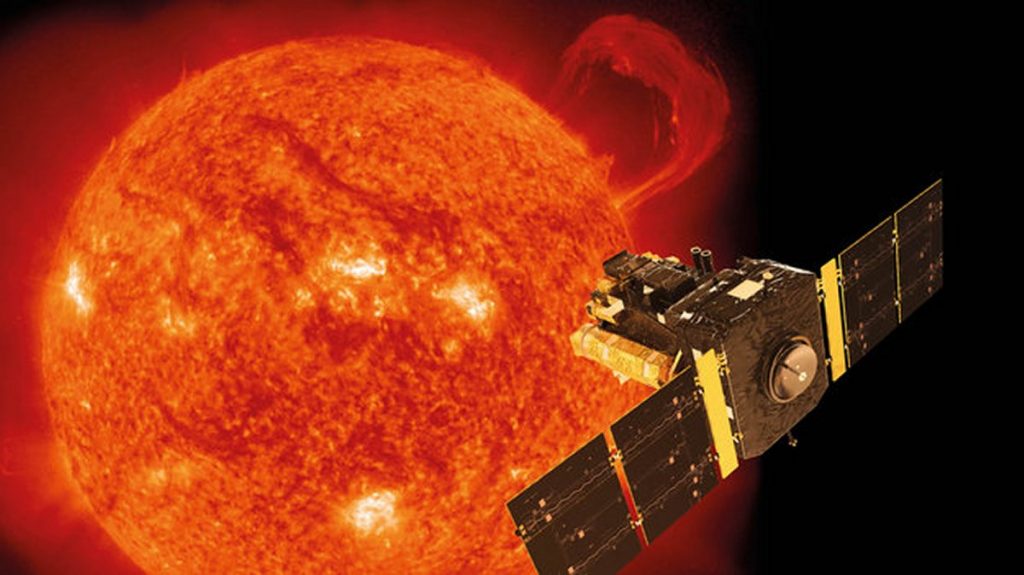
Artist’s impression of the ESA–NASA Solar and Heliospheric Observatory, SOHO, with the Sun as seen by the satellite’s extreme-ultraviolet imaging telescope on 14 September 1999. Credits: Spacecraft: ESA/ATG medialab; Sun: SOHO (ESA & NASA).

SOHO Celebrates 20 Fruitful Years Of Discoveries

MessageToEagle.com – Today is an important day for our scientific satellite SOHO. Solar and Heliospheric Observatory (SOHO), satellite managed jointly by the European Space Agency (ESA) and NASA is celebrating 20 fruitful years in space on Wednesday, 2 December. SOHO is equipped with a series of sophisticated instruments to study the Sun. When SOHO was launched on Dec. 2, 1995, it was originally

SOHO Celebrates 20 Fruitful Years Of Discoveries Read More »

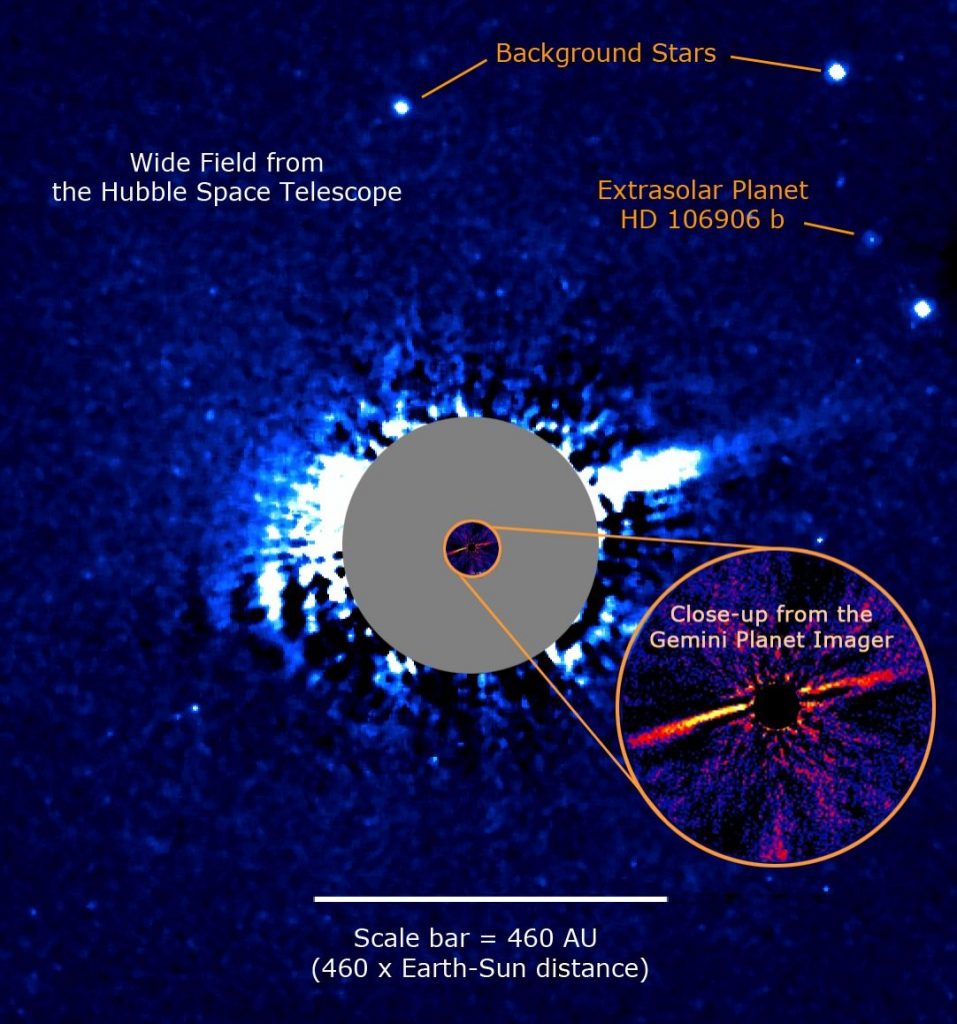
Two direct images of the cometary dust and exoplanet surrounding the young star HD 106906. The wider field in blue shows Hubble Space Telescope data where the star’s blinding light is artificially eclipsed (gray circular mask). The point to the upper right is an 11 Jupiter mass planet located over 650 times the Earth-Sun distance. A new discovery in these Hubble observations is an extremely asymmetric nebulosity indicating a dynamically disturbed system of comets. Surprisingly, the planet is located 21 degrees above the plane of the nebulosity. The circular orange inset shows a region much closer to the star that can only be detected using advanced adaptive optics from the ground-based Gemini Observatory. Using the Gemini Planet Imager (GPI), researchers found a narrow loop of nebulosity suggesting that a planetary system formed close to the star, but somehow the architecture of the outer regions is severely disrupted. The investigators also find that the planet HD 106906b may have a dusty ring system of its own, motivating future work with Hubble and ground-based astronomical observatories. Credit: Paul Kalas, UC Berkeley

Exoplanet May Have Been Kicked Out Of Its Birthplace – Is An Unknown Perturbation Involved?

MessageToEagle.com – A planet discovered last year sitting at an unusually large distance from its star – 16 times farther than Pluto is from the sun – may have been kicked out of its birthplace close to the star in a process similar to what may have happened early in our own solar system’s history. The

Exoplanet May Have Been Kicked Out Of Its Birthplace – Is An Unknown Perturbation Involved? Read More »

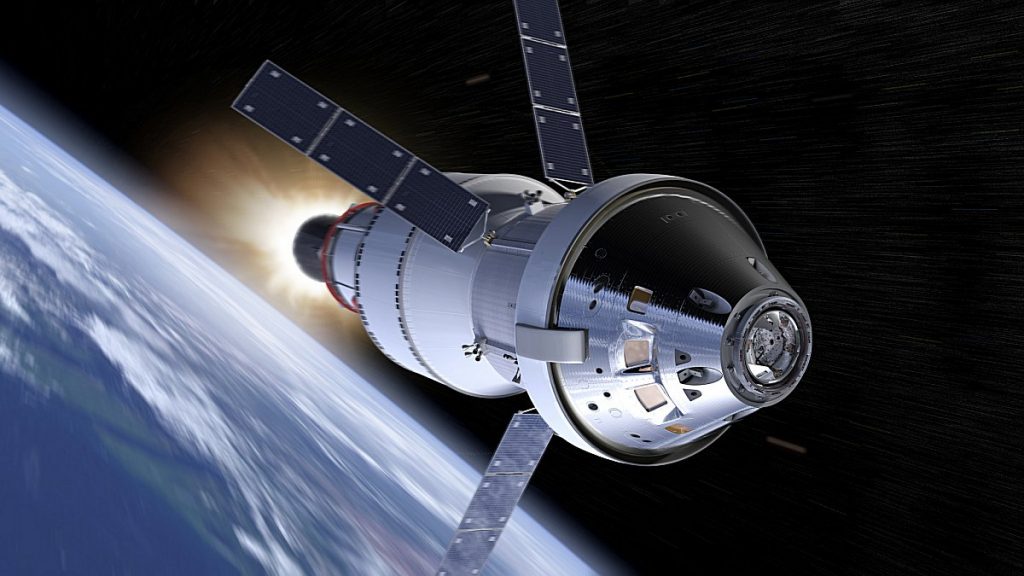
During Exploration Mission-1, Orion will venture thousands of miles beyond the moon during an approximately three week mission. Credits: NASA

NASA’s Orion Spacecraft Will Travel Thousands Of Miles Beyond The Moon

MessageToEagle.com – NASA is hard at work building the Orion spacecraft, Space Launch System (SLS) rocket and the ground systems needed to send astronauts into deep space. The agency is developing the core capabilities needed to enable the journey to Mars. Orion’s first flight atop the SLS will not have humans aboard, but it paves the

NASA’s Orion Spacecraft Will Travel Thousands Of Miles Beyond The Moon Read More »